Key achievements for 2023-24
The department has been working with partners to implement actions across all five priority areas. Major highlights over the 2023-24 period included:
- Sydney Water’s completion of their ‘Our Water Our Voice’ customer engagement program which enabled greater understanding of customer attitudes towards water supply resilience.
- Establishment of a Metropolitan Water Climate Change Working Group.
- Activation of the Climate Change Fund to deliver key water efficiency activities under the joint Sydney Water and Department of Climate Change, Energy, Environment and Water – Water Group’s (DCCEEW– Water) Water Efficiency Plan.
- Completion of the annual update to the Greater Sydney Drought Response Plan including drought indicators monitoring and a draft interim drought asset response plan.
- The opening of Sydney Water’s Purified Recycled Water (PRW) Discovery Centre to the public and visits of over 2000 people to the plant.
- Amendment of the Water Management (General) Regulation to allow Sydney Water to apply for a Specific Purpose Access Licence to capture excess stormwater in the Mamre Road and Aerotropolis precinct.
- Delivery of the draft Water Quality Governance Roadmap by DCCEEW Water
- Development of the draft Greater Sydney Water Quality and River Health Monitoring Governance Options Report
- Development of the Integrated Water Cycle Management (IWCM) Framework
- Introduction of developer charges for drinking water, wastewater and stormwater services from 1 July 2024
- Completion of the BASIX Water Review - Stage 1; a review of the water components of the NSW Building and Sustainability Index (BASIX) (Statewide Policy Review)
Annual monitoring, evaluation and review process
Annual monitoring, evaluation and reporting ensures the Greater Sydney Water Strategy (the Strategy) is implemented as intended. It provides transparency and accountability for delivering the implementation plan and supports adaptive management.
The Water Group is responsible for leading the annual review process and collaborates closely with Sydney Water and WaterNSW for needed data and information. The process includes monitoring actions in the implementation plan against milestones and targets, as well as a broader evaluation of progress in delivering against the priorities.
This report highlights some of the key achievements over the implementation period up until the end of June 2024. It also identifies where there may be future challenges or opportunities, recognising the need to be adaptive in implementing the strategy in an increasingly complex environment.
Greater Sydney Water Strategy
Understand how much water we need and when
- Change the way we think about future water needs (enduring supply)
- Consider future drought and climate risks
Our water systems are sustainable for the long term and resilient to extreme events
- A concentrated focus on water conservation and efficiency
- Make best use of the assets we have by optimising use of the Sydney Desalination Plant
- Plan for new infrastructure with a focus on rainfall independent supply
- Managing drought
- Manage location-specific or asset-specific risks
- Respond to the impacts of flood mitigation decisions on the system
Our city is green and liveable
- Integrate water cycle and land use planning
- Support the design principles for Greater Sydney
- Prioritise alternative water sources for greening and cooling
- Progress a circular economy approach for water services
Our waterways and landscapes are healthy
- Maintain and improve ecosystem health
- Invest in wastewater management
- Improve stormwater management
- Protect water for recreation
Water management and services meet community needs
- Recognise and protect Aboriginal rights, interests and access to water
- Enhance community confidence through engagement and transparency
- Manage price impacts for customers
- Monitor implementation progress and regularly review and update Greater Sydney Water Strategy
| 41 Implementation Actions |
|---|
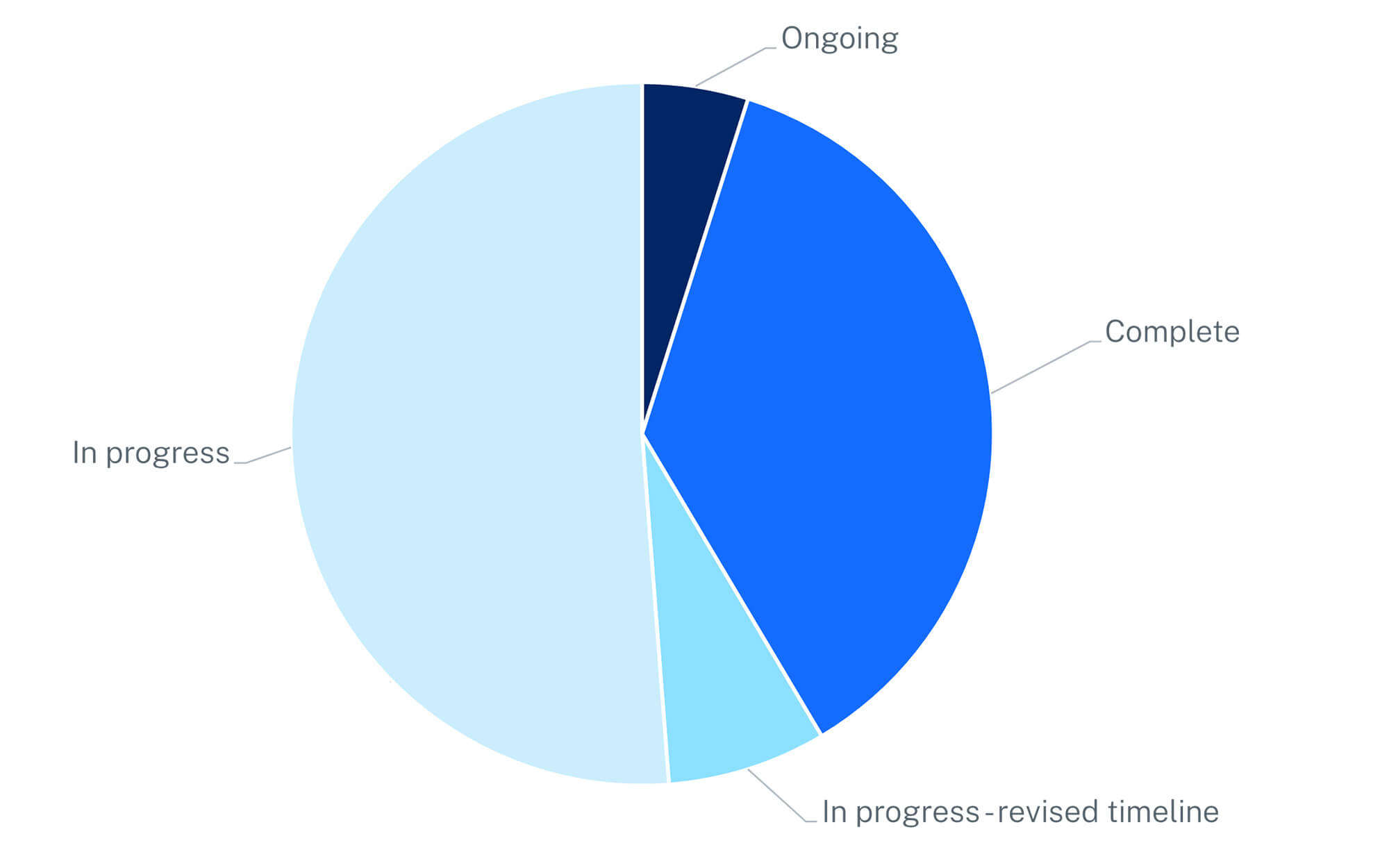
Of the 41 actions in the Greater Sydney Water Strategy, 15 actions in the implementation plan have been completed, 21 are in progress, 3 are in progress with a revised timeline and 2 are ongoing.
Priority 1 – We understand how much water we need and when
- Sydney Water have completed their customer-led engagement program ‘Our Water, Our Voice’. The program engaged customers on a wide range of topics to understand their expectations and their priorities for the future. Through this Sydney Water has gained insights about attitudes to water supply resilience, water restrictions, minimum water demands as well as an understanding of customer expectations for the level of service that Sydney Water provides. Findings from the program have been used to inform Sydney Water’s IPART price submission.
- Customer expectations for water use during long and severe droughts combined with modelling data will inform decision making on water management and supply options to be further explored in 2025.
- The Office of Energy and Climate Change released the NSW Climate Change Adaptation Strategy in June 2022. The department has since undertaken a climate risk assessment to understand the potential impacts of climate change on assets and services and a draft NSW Climate Action Plan is under development.
- Stochastic climate change modelling data sets for Greater Sydney have now been uploaded on the Sharing and Enabling Environmental Data portal.
- The department, Sydney Water, WaterNSW, and Hunter Water are working together to develop a framework to support climate change modelling and decision making, including approaches to using the newest climate change projection dataset, the NSW and Australian Regional Climate Modelling (NARCliM) 2.0 dataset.
Priority 2 – Our water systems are sustainable for the long term and resilient to extreme events
- Sydney Water and Water Group have worked together to develop a joint 5-year Water Conservation Plan for Greater Sydney. The plan maps out a range of activities to deliver 38 billion litres of water savings by 2030, with a view of achieving the 49 billion litres of savings by 2040 as set out in the Greater Sydney Water Strategy. At the end of 2023-24 Greater Sydney was tracking at around 24 billion litres of water savings towards this target.
- The department will deliver a number of initiatives over the next 5 years to support the delivery of the joint Water Conservation Plan with funding support from the Climate Change Fund. This will include Water Sensitive Urban Design guidelines, a review and enhancement of regulatory mechanisms that encourage more efficient use of water, a residential equity program to support access to water efficient washing machines, and revision and identification of opportunities for BASIX to address broader water requirements and identifying possible updates for more immediate (2025) BASIX water updates along with longer term (2028) updates.
- The Water Conservation Plan also includes customer and community water savings programs led by Sydney Water such as WaterFix™, education and engagement programs that support customers in making timely and informed water wise choices, improvement initiatives for better management of water loss from the water supply network, and trial programs to explore new water conservation opportunities.
- The Sydney Desalination Plant is now able to make a greater contribution to water supply resilience and drought security through the introduction of a more flexible operating environment.
- The new licence for the Sydney Desalination Plant supports the shift to flexible, full-time operation and has been in place since 1 July 2023. A framework is in place to guide decision making and aims to balance increases in water security with costs to customers.
- Sydney Water’s Resilient and Reliable Water Supply strategic business case was completed in 2023. It analyses a range portfolios of rainfall-independent supply augmentation, system resilience and water security options in terms of scale and cost.
- The Resilient and Reliable Water Supply was developed with several augmentation pathways in mind, each with various scales of rainfall-independent supply, resilience benefits, and costs. Work is currently underway to progress infrastructure priorities and readiness activities for longer-term options including desalination and purified recycled water. The scale and timing for delivery of projects that support the Resilient and Reliable Water Supply will be adapted based on ongoing reviews of forecast demand and in response to new supply challenges.
- Planning for expansion of Sydney Desalination Plant is ongoing. It is anticipated that future directions for expansion of the plant will be confirmed by government in 2025.
- Sydney Water are progressing planning for their first full scale Purified Recycled Water Scheme and published a scoping report (Securing our Water supply – Quakers Hill to Prospect) in 2024. Work towards obtaining planning approvals for the project and community engagement work to understand sentiment towards purified recycled water is ongoing.
- The Greater Sydney Drought Response Plan (GSDRP) sets out how WaterNSW, Sydney Water and the NSW Government will work together to respond to future droughts. The plan includes drought monitoring, governance and decision-making, roles and responsibilities, and drought response action plans for each stage of drought.
- The GSDRP is reviewed annually and adjusted as needed so that it maintains relevance. A key revision in the 2023 GSDRP included the addition of key actions to be considered at different phases of drought and a timeline to provide guidance on the potential length of these drought phases based on storage depletion forecasts.
- While Greater Sydney remained drought-free in 2023-24 key actions in the GSDRP are still progressing under normal operations to support drought preparedness.
- Long-term capital and operating plans were updated for both Sydney Water and WaterNSW in 2023 to guide infrastructure and investment decisions out to 2050. The plans address water, wastewater and recycled water and map out how these services will be provided over the long term in response to the challenges of population growth, changing customer expectations, climate change, evolving technology and ageing infrastructure. The plans were also used to inform Sydney Water and WaterNSW’s price submission to IPART.
- The delivery of the investments in the long-term capital and operating plans will improve services for the people of Greater Sydney, support growth and environmental outcomes, and will increase the level of supply from rainfall independent sources.
- Individual investments, including considerations for community acceptance and costs, will be evaluated over time and will be subject to government regulatory and approvals processes before they are operationalised.
- Sydney’s Water’s Purified Recycled Water Demonstration Plant and Discovery Centre has been constructed and was opened for community tours in 2024. The facility is the first of its kind in NSW. It presents an opportunity to engage with the community on the importance of rainfall independent supply options and build water literacy.
- To address flood risk in the Hawkesbury-Nepean Valley, the NSW Reconstruction Authority is prioritising a disaster adaptation plan for the region, the first of its kind in the state. There is no single solution for reducing flood impacts in the valley, and the plan will include a suite of integrated measures to reduce the risk where possible and adapt where not possible. This work will consider impacts on water security and the priorities of the Greater Sydney Water Strategy.
Priority 3 – Our city is green and liveable
- As part of the NSW Water Strategy, the department is undertaking a project to better integrate land use planning and water management. Phase 1 of this project is complete and has provided 63 recommendations. This was informed by two key bodies of work:
- Research to map out the legislative and strategic planning pathways where land use planning and water planning intersect.
- Issues analysis of contemporary barriers to integrating land use planning and water management as informed by over 50 stakeholder consultations across state agencies, water utilities (state-owned corporations and local water utilities) and local councils.
- Findings from the project to better integrate land use planning and water management have informed the scope and key actions to be delivered under the NSW Government’s Housing Approval Reform Action Plan and the integrated catchment management work program.
- Waterway health targets have been set for the Wianamatta - South Creek catchment in Western Sydney to mitigate the impact of rapid urbanisation on waterways. As the regional stormwater drainage authority for the Mamre Road and Aerotropolis precincts, Sydney Water have designed a stormwater scheme plan to achieve these waterway health targets, keep water in the landscape and offer improved amenity in line with the vision for a cool green Western Parkland City.
- In 2023, the department reviewed barriers and opportunities for IWCM using Sydney Water’s Aerotropolis and Mamre Road project as a case study. The review identified key features to form the basis of an IWCM framework, estimated to be published in early 2025. The framework identifies the common features of IWCM and by drawing on this guidance, organisations will be better placed to improve the design and establishment of new urban communities, urban infill and urban redevelopment; and achieve greater community value from linking water infrastructure investment and land development.
- The stormwater infrastructure required to meet the waterway health targets in the Mamre Road precinct is significant and in 2024 IPART reviewed the scheme to confirm efficient costs and distribution of costs as the basis for setting developer contributions.
- The department completed the first stage of a review of the Building and Sustainability Index for water (BASIX) in 2023. BASIX applies to all residential dwellings in NSW and sets out planning requirements to drive more efficient homes. The review identified eight recommendations that will form the basis of a second review in 2024-25. This forward work program will include updates to the BASIX tool to improve water saving confidence and longer-term ground truthing studies to build an evidence base for further improvements to the program. Changes in BASIX will also support delivery of the water conservation targets in Priority 2 of the Greater Sydney Water Strategy.
- To support the water conservation targets in the Greater Sydney Water Strategy, the department partnered with the National Australian Built Environment Rating System (NABERS) on the Water Starters project, providing financial contributions to drive continuous improvement and increase the uptake of NABERS ratings in NSW.
- As an action under the NSW Water Strategy, the department is developing the Recycled Water Roadmap. The draft Recycled Water Roadmap was released in 2024 and it identifies actions, case studies and opportunities for government to facilitate the increased use of recycled water for both drinking and non-drinking purposes. Engagement on the Recycled Water Roadmap will continue in 2024-25 before it is finalised.
- Sydney Water has designed and implemented a formal governance model leading to the development of strategic measures and targets to drive the organisation’s commitment of circular economy more formally and further.
- Sydney Water has set a target of reaching net zero scope 1 and 2 emissions by 2030, which has been supported by customers. Sydney Water is currently on track to meet this target by focusing on self-generated renewable electricity, power purchasing arrangements and carbon offsets. Sydney Water continues to work with our supply chain to achieve net zero scope 3 emissions by 2040.
- Work is also progressing by Sydney Water to develop partnerships with local government and other stakeholders for a circular economy hub located adjacent to the Advanced Water Recycling Centre in Western Sydney.
Priority 4 – Our waterways and landscapes are healthy
- The department has been reviewing community environmental values and uses for all waterways in coastal NSW by engaging with communities and stakeholders to understand how they value their waterways. The feedback from this stakeholder engagement will be used to revise the NSW Water Quality Objectives.
- To further this work and incorporate Indigenous cultural values, the department has completed a cultural mapping exercise of Indigenous cultural values for waterways. These maps have been converted to cultural care maps to inform masterplans and prioritise actions for land use and water infrastructure delivery.
- As part of implementation of the NSW Water Strategy research and analysis was undertaken into current roles and responsibilities for water quality management and monitoring across NSW. The NSW Water Quality Governance Roadmap PDF, 4577.59 KB was published in June 2024 and identifies opportunities to improve water quality outcomes. Two key pathways are currently being progressed by the department - an integrated catchment management work program that will explore reforms to transition NSW to having an integrated catchment management policy and governance approach; and the development of a new, statewide water quality monitoring framework to enable data to be used more effectively to manage water quality issues in a timely manner for incident response and broader catchment health.
- Coastal management programs are currently being prepared by local councils with department support for the Hawkesbury Nepean, Northern Beaches, Sydney Harbour, Eastern Beaches, Cooks River, Georges River and Bate Bay, and Sutherland Shire Council is also considering developing a coastal management program for the Hacking River. Coastal management programs set the long-term strategy for coordinated management of the coast, identify coastal management issues and the actions required to address these issues, enabling councils to apply for grant funding to fund these actions.
- The business case for Warragamba environmental flows has been finalised. The project aim is to help offset the environmental impacts of Warragamba Dam by allowing variable environmental flows to be released from the dam, more closing mimicking natural flow patterns downstream of the dam which is important to maintain biodiversity and ecosystem health. The project will deliver outcomes for waterway and ecological health and public amenity. Work to secure an investment decision on the project and finalise timelines for project works is underway.
- The Water Sharing Plan for the Greater Metropolitan Region Unregulated River Water Sources 2023, which includes rules for scaled environmental flow releases from Tallowa and Nepean dams, was gazetted on 1 July 2023. A baseline monitoring program will be in place to provide important information about the benefits of environmental flows when they commence.
- The department is providing financial support to the Parramatta River Catchment Group to plan stormwater compliance and education programs and riverbank naturalisation initiatives to improve catchment health. The department has also committed funds to the Cooks River Alliance for the development of a catchment wide Master Plan for the Cooks River.
- Sydney Water has continued to update its approach to reducing wet weather wastewater overflows. Sydney Water has invested in cost effective works to reduce the amount of water that gets into wastewater pipes in wet weather and reduce stormwater flows to sewer connections. Sydney Water has been working with the EPA to prioritise areas with the highest environmental and recreational values.
- Enhancements to Sydney Water dry weather overflow program include enhanced proactive maintenance and inspections, improved detection of faults including through CCTV inspections and Internet of Things sensors, pipe relining and improved response. Sydney Water’s new choke management plan is being used to prioritise works to reduce and address the impact of chokes in wastewater pipes to improve dry weather overflow management.
- The new Sydney Water Aquatic Monitoring program was introduced in July 2023. The program was designed in collaboration with the Environment Protection Authority, to enable monitoring to better quantify the impacts (positive and negative) of Sydney Water’s water resource recovery facilities, sewer overflows and leakage on aquatic environments. In the first year of the program Sydney Water included new water quality monitoring sites upstream and downstream of Water Resource Recovery Facilities, included monitoring at macroinvertebrate reference sites and updated the programs analyte suite.
- Sydney Water is working with partners to deliver pilot nutrient offset and research projects in the Hawkesbury-Nepean catchment. Projects include a raingarden at Glenbrook and bank stabilisation works at Camden, and a pilot offset project at Picton is currently in planning. These pilots help build understanding of how well different types of green infrastructure reduce nutrients in waterways, and how well they can offset nutrients that are discharged from wastewater treatment plants. Ongoing research in this area will also inform an overall sustainable nutrient approach for the Hawkesbury-Nepean River.
- The department and Sydney Water are continuing to work together to refine the regional approach to stormwater management in the Aerotropolis and the Mamre Road precinct.
- In 2023, the department completed amendments to the Water Management (General) Regulation to create a new Specific Purpose Access Licence called ‘unregulated river access licence, with a subcategory of “Mamre Road precinct and Western Sydney Aerotropolis precinct stormwater management”’. This licence has allowed Sydney Water to apply for a new type of Specific Purpose Access Licence SPAL to capture excess stormwater in the Mamre Road and Aerotropolis precincts and carry out their role as stormwater manager. Capturing excess stormwater is critical to achieving waterway health targets for the Mamre Rd industrial precinct and the Aerotropolis.
- The department is continuing to support waterway managers and industry to improve or maintain the water quality and ecosystem health of NSW coastal catchments by building capacity in applying the Risk-based Framework for Considering Waterway Health Outcomes in Strategic Land-use Planning Decisions.The department has provided guidance including fact sheets, case studies, guidelines, a dashboards, training modules, communities of practice, e-learning resources and models to help manage the impacts of land use activities on the health of NSW waterways.
- Sydney Water is continuing to provide strategic planning advice and delivery support to catchment groups and councils in the Cooks River, Parramatta River, Georges River and Sydney Harbour areas to improve stormwater and waterway management. The department is supporting local councils across Sydney with specialist technical advice to deliver 85 projects under the NSW floodplain management program.
- The Department of Planning, Housing and Infrastructure have now published their Places to Swim best practice guide. The guide will support councils, landscape architects, open space planners, policy makers, community champions and non-government agencies in developing new swimming and water recreation sites on natural waterways.
- The Parramatta River Catchment Group published the Parramatta River Masterplan in 2018. The document sets out a 10-step process to make the river swimmable by 2025. Sydney Water is the lead coordinating agency overseeing delivery of the Masterplan. Canada Bay Council, in collaboration with Sydney Water and the Parramatta River Catchment Group, launched Bayview Park Baths in 2022 and McIlwaine Park riverside recreation site in 2023. City of Ryde also opened Putney Beach in January 2025, with a further site at Bedlam Bay expected to come online later this year.
- Sydney Water launched its Urban Plunge program in 2022 to support the opening of swim sites in more waterways across Greater Sydney. Under the program, Sydney Water have developed new tools, processes and partnerships to make it faster and easier to open new sites. Further sites are now being explored in a range of locations across the city.
Priority 5 – Water management and services meet community needs
- The department’s Aboriginal Water Program has been working to build relationships and to work with Aboriginal communities across NSW on water matters including waiving licence fees for cultural water applications, establishing Regional Aboriginal Water Committees and establishing an Indigenous cultural and intellectual property protocol to protect the rights that Aboriginal people have to their cultural heritage.
- The department is looking forward to delivery of the final Aboriginal Water Strategy in 2024-25, with a draft released in August 2024 and supported by a comprehensive stakeholder engagement program.
- Sydney Water completed their customer-led engagement program ‘Our Water, Our Voice’. This program engaged customers on a wide range of topics to understand their expectations and their priorities for the future, including insights about attitudes to water supply resilience, supply options waterway health and water restrictions.
- For the 2025-2030 pricing proposal to IPART, WaterNSW adopted a three-phase engagement process to understand what matters to customers, community, and stakeholders and explore options to achieve priority outcomes, considering price and affordability.
- Sydney Water continues to promote water wise behaviours, build water literacy and awareness of water efficiency through their community education program. They are continuing to educate the community with the Wonders of Water discovery van, promotion at events such as sporting matches and through the Purified Recycled Water Demonstration Plant and Discovery Centre which opened for community tours in 2024.
- From 1 July 2024, infrastructure contributions for drinking water, wastewater and stormwater services were reintroduced through a phased introduction with the increase to full contributions occurring over several years. The contributions will help recover the cost of providing infrastructure to new developments.
- In 2024 Sydney Water and WaterNSW submitted their next price proposals to IPART which outline their investment portfolio and expected customer prices for the next 5 years. IPART will review both Sydney Water and WaterNSW’s proposals against their new 3Cs Framework (costs, customers and credibility). This framework aims to deliver better value for money to customers and address key challenges like climate change and a growing population.
- Sydney Water offers social assistance programs to customers that may struggle with affordability including PlumbAssist, pensioner concessions and the Payment Assistance Scheme. These programs will be reviewed by IPART as part of the price determination.