Delivering the program
The Restoring the Darling-Baaka program was initiated in response to the Office of Chief Scientist and Engineer independent review into the 2023 fish deaths in the Darling–Baaka River at Menindee. See the Government full response (PDF, 14287.19 KB).
The NSW Government has committed to reporting on progress every six months throughout the four-year program.
The program is delivering significant outcomes for the Darling-Baaka and beyond including:
- Over 15,800 fish have used our new temporary fishway at Lake Wetherell during Season 2 to date, which commenced on 26 September and will operate to April 2026. The improved fish passage at the site allows fish to find new homes, more food, and spawn and recruit along the Baaka River. This exceeds the total of 7,000 fish movements recorded in Season 1, which operated from January to April 2025.
- Using better data from enhanced monitoring and modelling to strategically release water to avoid conditions that lead to fish deaths on at least 10 occasions over the last 24 months.
- A total of 15 water quality datasets are available on the NSW Government SEED portal, up from 10 in August 2025. Greater accessibility to this data brings greater transparency, supports evidence-based decisions, and enables communities to better understand and engage with the health of their local rivers.
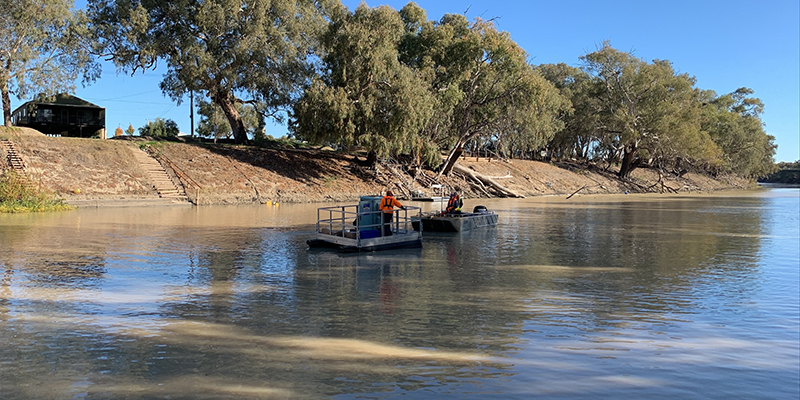
- The additional monitoring pontoons in Lake Wetherell and the Menindee weir pool have been integral in providing data for making decisions on water releases.
- These data allow us to see the impact that the different water release rates have on the water column and along the stretch of the weir pool. We can then adjust releases to meet objectives.
- The Incident Action Plan (IAP) is revised every year in time for summer, which is the high-risk period for deteriorating water quality and fish deaths. The triggers in the IAP and actions detailed in response have been used successfully over the last 3 years to prevent fish deaths in the weir pool.
Action status summary
The Restoring the Darling–Baaka River program includes 261 actions to address the recommendations of the Office of the Chief Scientist and Engineer.
Action status | March 2025 | August 2025 | February 2026 |
Action complete
Work is complete and now business as usual | 10 | 14 | 16 |
Action in progress
Work has commenced | 13 | 10 | 9 |
Action in progress under a revised timeframe
Work has commenced but will take longer than expected | 3 | 2 | 1 |
Action No. | March 2025 status | August 2025 status | February |
| FR1 - Develop an Integrated Catchment Management Work Program |  | | |
| FR2 - Make amendments to the Water Sharing Plans for NSW Border Rivers, Gwydir, Namoi, Macquarie and Barwon-Darling |  | | |
| FR3 - Make amendments to the Water Sharing Plan for the Murray and Darling Regulated River Water Sources 2016 | | | |
| FR4 - Improve operating arrangements for Menindee Lakes and deliver review | | | |
| FR5 - Review and update the Menindee water quality incident action plan |  | | |
| FR6 - Review and update the Water Quality Incident Management Plan | | | |
| FR7 - Develop the NSW water quality monitoring framework | | | |
| FR8(a) - Conduct a Weir 32 pool scientific study | | | |
| FR8(b) - Develop a hydrodynamic model | | | |
| FR8(c) - Purchase and install dissolved oxygen buoys and data loggers | | | |
| FR9 - Maintain and operate dissolved oxygen sensors | | | |
| FR10 - Installation of 40 water data sensors | | | |
| FR11 - Develop and publish a Menindee–specific Mass Fish Death Response Sub Plan | | | |
| FR12 - Exercise the Interim Mass Fish Death Event Response Sub Plan | | | |
| FR13 - Mass Fish Death Event Sub Plan Exercise | | | |
| FR14 - Update the Local Emergency Management Committee Information Guide | | | |
| FR15 - Resource review for Mass Fish Death Response Sub Plan | | | |
| FR16 - Complete the capability assessment of emergency services | | | |
| FR17 - Develop an emergency Communications Plan and confirm Public Information Services Functional Area under the Mass Fish Death Event Sub Plan | | | |
| FR18 - Improved and ongoing non-emergency communications and engagement plan | | | |
| FR19 - Enhanced education materials and links to relevant information | | | |
| FR20 - Trial and evaluate the feasibility of oxygenation infrastructure | | | |
| FR21 - Trial of new fish passage technologies | | | |
| FR22 - Replacement of existing fishway at Burtundy Weir | | | |
| FR23 - Full business case for permanent fish passage in the Menindee Lakes and Lower Darling-Baaka | | | |
| FR24 - Native Fish Recovery and Resilience program | | | |
| FR25 - Support the Australian Government to deliver the Carp Biological Control Program | | | |
| FR26 - Scope a “trap and transport” short-term solution | | | |
1. Reporting on full response action 8 (FR8) is broken into three distinct actions for clarity and transparency.
Previous public reports on the Restoring the Darling-Baaka River program can be found here:
Recommendation 1:
Regulatory environmental protections must be enforced
Integrated catchment management is an approach to coordinating the management of land use, water and natural resources across a catchment to improve ecosystem outcomes. It involves integrating policy frameworks across land use planning, water planning, biodiversity and other natural resources, which all influence water quality and water availability in a catchment.
Preparing an integrated catchment management program is expected to improve the way land and water is managed to improve water quality and other environmental outcomes.
| Deliverable | Status | February 2026 update | Target date |
|---|---|---|---|
| Develop an Integrated Catchment Management Work Program | | Last six months Multi-agency engagement has continued to test proposed reform options and inform governance design. Next six months This work program will result in preferred reform options being presented to the NSW Government in June 2026. More information | June 2026 |
This action is to make amendments to water sharing plans in the NSW Border Rivers, Gwydir, Namoi, Macquarie and Barwon-Darling valleys which consider the findings of the independent Connectivity Expert Panel’s final report. These amendments are expected to result in greater connectivity of these rivers to improve environmental outcomes.
| Deliverable | Status | February 2026 update | Target date |
|---|---|---|---|
| Make amendments to the Water Sharing Plans for NSW Border Rivers, Gwydir, Namoi, Macquarie and Barwon-Darling | | Last six months It is important to note that recommendations in the Connectivity Expert Panel’s report were made independent of government and are not government policy. No decision has been made on what steps the NSW Government will take to improve connectivity into the Barwon-Darling River. The findings and recommendation of the Connectivity Expert Panel are just one of many considerations. Next six months More information | December 2026 |
This action is to make amendments to the Water Sharing Plan for the Murray and Lower Darling Regulated River Water Sources 2016 that consider the findings of the Independent Connectivity Expert Panel’s final report. These amendments are expected to result in greater connectivity of these rivers to improve environmental outcomes.
| Deliverable | Status | February 2026 update | Target date |
|---|---|---|---|
| Make amendments to the Water Sharing Plan for the Murray and Darling Regulated River Water Sources 2016 | | Next six months DCCEEW Water will consider the Independent Connectivity Expert Panel's recommendations as part of the remake of the Water Sharing Plan for the New South Wales Murray and Lower Darling Regulated Rivers Water Sources 2016. Targeted consultation is proposed for early 2026. The target date of June 2028 is subject to extension approval by the Minister for Water. More information | June 2028 |
This action is to identify and seek improvements to the operating arrangements for the Menindee Lakes to better mitigate environmental incidents arising from declining water quality, including actively engaging in the scoping and delivery of a review requested by the Basin Officials Committee (made up of officials from NSW, Victorian, South Australian and Commonwealth governments).
The Murray-Darling Basin Authority (MDBA), acting on behalf of these governments, will manage the conduct of the review in multiple stages.
Changes to the operating arrangements at the Menindee Lakes are intended to provide new tools to help manage developing water quality events.
| Deliverable | Status | February 2026 update | Target date |
|---|---|---|---|
| Improve operating arrangements for Menindee Lakes and deliver review | | Last six months Next six months More information
| December 2027 for the package of options for improving Menindee operations, pending further decision from the Basin Officials Committee |
The Menindee Water Quality Incident Action Plan sets out how to respond in the event of a water quality incident occurring or indications that it will occur at Menindee. The Incident Action Plan documents the actions we will take at Menindee when specific triggers are met.
The incident action plan is implemented by the Menindee / Lower Darling Water Quality Working Group – who meet at least weekly over the summer months – on water quality monitoring outcomes, options and actions to manage poor water quality. The updated incident action plan was applied over the 2025/26 summer period.
| Deliverable | Status | February 2026 update | Target date |
|---|---|---|---|
| Review and update the Menindee water quality incident action plan | | The review and update were completed in December 2024. The Menindee Water Quality Incident Action Plan informs decisions by the Menindee/Lower Darling Water Quality Working Group to actively undertake variable water releases from the upper Lakes into the Menindee weir pool in response to specific water quality triggers to avoid hypoxic conditions. More information | December 2024 Updated annually. |
This action is to review the Water Quality Incident Management Plan in relation to managing low dissolved oxygen and update it to reflect lessons learned from water quality issues and mass fish deaths observed in 2022–23 and 2023–24.
The purpose of the Water Quality Incident Management Plan is to provide a mechanism for an inter-agency approach to hypoxic water quality event in the NSW Murray Darling Basin.
| Deliverable | Status | February 2026 update | Target date |
|---|---|---|---|
| Review and update the Water Quality Incident Management Plan | | The review and update were completed in December 2024. The review incorporates learnings from the hypoxic event management into the plan and clarifies agency roles and responsibilities in hypoxic event response. | December 2024 |

Recommendation 2
Better decisions require better data
Water quality data is collected, stored and used by a range of state government agencies as well as councils. It is important to improve visibility of data held among agencies and enhance transparency with the wider community regarding which organisations hold water quality data, the nature of the data, its completeness, accuracy and how to access it.
This action addresses gaps in water quality and river health data by developing a new NSW Water Quality Monitoring Framework. It aims to improve environmental outcomes and public awareness of water quality issues.
The water quality framework aims to develop and implement a statewide system for collecting, managing, sharing, and accessing water quality data across government agencies.
| Deliverable | Status | February 2026 update | Target date |
|---|---|---|---|
| Develop the NSW water quality monitoring framework | | Last six months New grouping functions on the SEED Portal are being trialled to improve accessibility to metadata and data assets. The NSW Surface Water Quality Monitoring group has been created on SEED to catalogue water quality datasets in NSW. Four water quality datasets have been added with additional assets to come. This will act as a public register to list water quality programs and data in NSW. Next six months This includes greater access to State Water Quality Assessment and Monitoring (SWAMP) program data. The SWAMP is a statewide project responsible for collecting, analysing and reporting the ambient water quality condition of rivers in NSW. A SWAMP dashboard has been developed and will be published, with the complete dataset available on SEED. Greater accessibility to this data brings numerous benefits to the people of NSW by making water quality information more transparent, supporting evidence-based decisions, and enabling communities to better understand and engage with the health of their local rivers. More information | Framework development: June 2025 Framework implementation: June 2026 |
The purpose of this action is to investigate the possible causes of the Golden Perch fish deaths that occurred in February and March 2024. The first stage aims to collect and collate evidence of conditions during the 2024 Golden Perch death event. The second stage will involve conducting more intensive and specialised sampling and laboratory analyses to identify more complex potential causes of the fish deaths.
| Deliverable | Status | February 2026 update | Target date |
|---|---|---|---|
| Conduct a Weir 32 pool scientific study | | Last six months The study found that poor sediment and water quality, slow flow velocities and over-crowding of fish within the Menindee weir pool combined to create conditions conducive to heavy parasite infections of fish. These infections targeted and weakened the golden perch and made them susceptible to bacterial infections which would have been otherwise survivable. Investigations into water quality, sediment quality and decapods found no ongoing effect of the 2023 mass fish death with poor sediments and water quality related to slow flows and impoundment from Menindee main weir rather than fish biomass. Next six months More information | June 2025 |
Hydrodynamic models can provide simulations of a range of flow and sediment transport scenarios. The planned hydrodynamic model will allow forecasts and predictions of dissolved oxygen conditions under various scenarios and the associated risk of fish deaths. The hydrodynamic model will aid water management decision-making through the data it provides. This action seeks to build upon work already under way through the Darling-Baaka River Health Project.
| Deliverable | Status | February 2026 update | Target date |
|---|---|---|---|
| Develop a hydrodynamic model | | Last six months The model uses readily available meteorological and river data including air temperature, solar radiation, wind speed, river discharge, depth, and width, to forecast stratification conditions and dissolved oxygen concentrations. The model can be run using daily input data, including telemetry from newly deployed smart buoys in the Menindee weir pool. The model was tested across seven sites in the Darling-Baaka system, with 5 sites within the Menindee weir pool and one each in the Wilcannia and Tilpa weir pools. It demonstrated high predictive accuracy (80–100%) at most sites, confirming the robustness of the underlying physics and assumptions. Next six months More information | September 2025 |
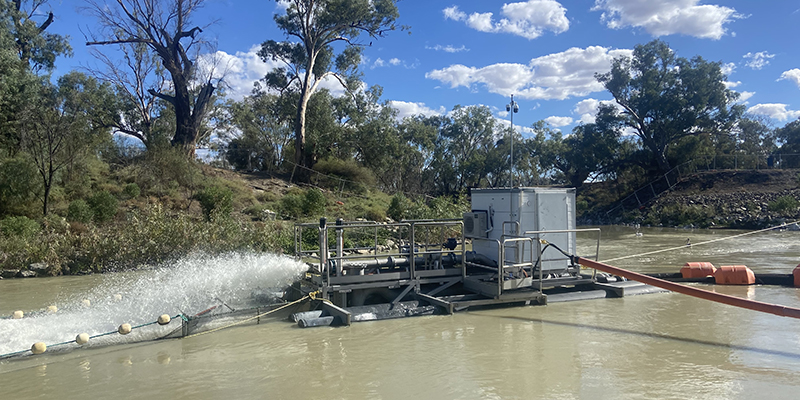
This action aims to install permanent multi-depth water quality monitoring buoys and upgrade existing dissolved oxygen monitoring sites to reduce maintenance costs and data error. There are three pontoons monitoring the quality of water entering the Lakes and moving through the weir pool (see FR9) providing data and being used for decision-making. The sensors will also be upgraded to include additional water quality parameters (dissolved oxygen, pH, turbidity, electrical conductivity, chlorophyll, temperature).
| Deliverable | Status | February 2026 update | Target date |
|---|---|---|---|
| Purchase and install dissolved oxygen buoys and data loggers | | Last six months Next six months More information | June 2025 |
This action’s purpose is to maintain and operate existing dissolved oxygen sensors in the Menindee weir pool and conduct additional manual sampling as required. Improving sensors’ performance and additional sampling will contribute to improved data to support better decision-making and ensure a whole of system approach to water quality management.
It is linked to the overall aim of creating an effective early warning system that draws on improved monitoring and modelling and a plan to activate strategies to mitigate fish death events.
| Deliverable | Status | February 2026 update | Target date |
|---|---|---|---|
| Maintain and operate dissolved oxygen sensors | | This action is ongoing. WaterNSW continues to maintain and operate the existing dissolved oxygen sensors to aid operational decision-making and availability of data for the community. More information | June 2028 |
Water data monitors aim to improve water data collection, management and transparency to ensure the NSW Government and the community have the right data to inform water management decisions.
This action will complete the installation of an initial 40 water data monitors in high–risk areas to provide real–time data on dissolved oxygen levels. Real time dissolved oxygen data will assist in identifying and assessing the level of risk and managing extreme water quality events. This information can be used to improve the management of water resources and to assess the success of water management decisions.
| Deliverable | Status | February 2026 update | Target date |
|---|---|---|---|
| Installation of 40 water data sensors | | Last six months A monitor at the Darling River upstream of Wilcannia (Trevallyn) is not yet installed due to current water levels as a result of recent inflows. It will be installed once conditions permit. A monitor at the escape from Mulwala canal at Edwards River has not yet been installed due to site access issues and Commonwealth Government approval processes. The monitor will be installed once these issues are resolved. Next six months More information | June 2025 |
Recommendation 3
Effective emergency management
This action is to develop Menindee-specific, emergency management arrangements for a mass fish death event, through a published Mass Fish Death Event Sub Plan (Sub Plan).
The Sub Plan will clearly explain triggers, stages of a response, clean-up measures and government agency roles and responsibilities for a mass fish death event. Related actions are FR12, FR13, FR15 and FR17.
| Deliverable | Status | February 2026 update | Target date |
|---|---|---|---|
| Develop and publish a Menindee–specific Mass Fish Death Response Sub Plan | | The Menindee Mass Fish Death Event Sub Plan was finalised and published in March 2025. Last six months
Next six months More information | March 2025 |
This action is to test the Interim Mass Fish Death Event Response Sub Plan at Menindee consistent with the Local Emergency Management Committee Exercising Toolkit – Spontaneous Volunteers.
| Deliverable | Status | February 2026 update | Target date |
|---|---|---|---|
| Exercise the Interim Mass Fish Death Event Response Sub Plan | | The exercise was delivered in June 2024, and the arrangements were tested regarding:
| June 2024 |
The Central Darling Local Emergency Management Committee (LEMC) is comprised of NSW Government agencies, Central Darling Shire Council and non-government organisations.
This action is to exercise the Menindee-specific Mass Fish Death Event Sub Plan by the Central Darling LEMC and NSW Government agencies.
| Deliverable | Status | February 2026 update | Target date |
|---|---|---|---|
| Mass Fish Death Event Sub Plan Exercise | | Last six months Next six months | June 2025 |
This action is to update the Local Emergency Management Committee (LEMC) Information Guide. This update aims to align the Information Guide to current good practice and reflect recent amendments made to the NSW Emergency Management Plan (EMPLAN) 2023. The Information Guide has been published on the Emergency Management Policy website.
| Deliverable | Status | February 2026 update | Target date |
|---|---|---|---|
| Update the Local Emergency Management Committee Information Guide | | This action was completed in July 2024. This followed a comprehensive review of the Central Darling LEMC and aligns the Information Guide to current good practice and reflect recent amendments made to the NSW EMPLAN 2023. More information | June 2024 |
This action is to complete a resource review as part of the preparation for a Mass Fish Death Event. It is linked to the Mass Fish Death Event Sub Plan-related actions; FR11, FR12, FR13 and FR17.
| Deliverable | Status | February 2026 update | Target date |
|---|---|---|---|
| Resource review for Mass Fish Death Response Sub Plan | | The resource review has been finalised. Site inspections were undertaken in November 2024 to confirm resources and equipment. Last six months Next six months | October 2024 |
This action is to complete a capability assessment of the emergency services functions and resources (assets/equipment) in Menindee, Central Darling Shire local government area, and the Far West Emergency Management Region.
The NSW Premier’s Department conducted the capability assessment with the support of the Local Emergency Management Committee (LEMC) and the Regional Emergency Management Officer (REMO).
| Deliverable | Status | February 2026 update | Target date |
|---|---|---|---|
| Complete the capability assessment of emergency services | | This action was completed in August 2024. The assessment highlighted insights that can be considered at the local, regional, and state level, including:
More information | August 2024 |
This action is to confirm the lead agency for communications (Public Information Services Functional Area) and develop an emergency Communications Plan under the Menindee–specific Mass Fish Death Event Sub Plan.
| Deliverable | Status | February 2026 update | Target date |
|---|---|---|---|
| Develop an emergency Communications Plan and confirm Public Information Services Functional Area under the Mass Fish Death Event Sub Plan Sub Plan | | An emergency Communications Plan was completed in March 2025. The Communications Plan ensures timely, accurate, and coordinated information sharing among government agencies and with the public and the local communities during a mass fish death event in the Menindee Weir Pool. More information | March 2025 |
This action is to build on existing communications and engagement with the Menindee community to improve the ongoing non-emergency communications and engagement in the Menindee region.
It aims to address the regional requirements of the community, the proactive release of information, and includes community consultation and feedback, such as two–way communication.
| Deliverable | Status | February 2026 update | Target date |
|---|---|---|---|
| Improved and ongoing non-emergency communications and engagement plan | | Last six months In December 2025, DCCEEW Water, the EPA and the MDBA gave a webinar to advise the public on the current and forecast conditions, what the Incident Action Plan (FR5) and Mass Fish Death Sub Plan (FR11) are and how they work. | Ongoing |
This action is to deliver enhanced education materials and links to relevant information on partner websites from the DCCEEW Water website. It aims to build on existing materials across a range of state and federal government websites to ensure communities, customers and stakeholders have online access to educative materials that enhance their understanding of water management and other water related issues.
| Deliverable | Status | February 2026 update | Target date |
|---|---|---|---|
| Enhanced education materials and links to relevant information | | Website updates and new educational materials were published in June 2025. This work will be ongoing with new materials added regularly. This will ensure that communities, customers and stakeholders have online access to educative materials that enhance their understanding of water management and other water related issues. More information | December 2024 |

Recommendation 4
Interventions to mitigate against future mass fish deaths
This action is to complete the trial and evaluate the feasibility of oxygenation infrastructure. It involves the installation, operation, and maintenance of a temporary micro-bubbling machine in the Weir 32 weir pool and monitor dissolved oxygen levels. The data can then be used to evaluate the feasibility of oxygenation infrastructure as a fish death event mitigation strategy.
| Deliverable | Status | February 2026 update | Target date |
|---|---|---|---|
| Trial and evaluate the feasibility of oxygenation infrastructure | | The micro-bubbling oxygenation machine was installed, operated and decommissioned in June 2024. The evaluation report has been finalised. The trial has shown that microbubble oxygenation of bottom waters is possible under low flow conditions. More information | September 2024 |
This action is to complete a trial of new fish passage technologies including the tube fishway with fish sorting opportunities.
The intent of this action is to identify technology that can be easily and cost-effectively retrofitted to existing structures to enhance fish passage and allow fish to escape poor water quality events and reduce the chance of future mass fish deaths. FR26, which is an action to scope “trap and transport” by fish sorting, is part of this action.
| Deliverable | Status | February 2026 update | Target date |
|---|---|---|---|
| Trial of new fish passage technologies | | Last six months Daily fish movements show a clear association with releases from nearby regulators, reinforcing the role of flow cues in driving movement of key species such as Golden Perch. Species diversity has increased this season, including first detections of Murray Cod and Australian Smelt, as well as increased numbers of Golden Perch. Ongoing improvements to camera coverage and lighting have strengthened AI performance, although turbidity remains a key limitation. Next six months More information | June 2028 |
This action is to complete replacement of the existing fishway at Burtundy Weir. It involves the construction and commissioning of a new fishway at Burtundy Weir in the Lower Darling-Baaka River in Western New South Wales (NSW).
The new fishway is part of the Lower Darling Fish Passage Program which was established as part of the Australian Government’s response to the fish deaths in the 2018-19 summer in the Lower Darling River. Burtundy Weir is located 133 km upstream from the confluence of the Lower Darling-Baaka River and the River Murray and is the first barrier experienced by fish heading upstream from the Murray River junction.
| Deliverable | Status | February 2026 update | Target date |
|---|---|---|---|
| Replacement of existing fishway at Burtundy Weir | | Last six months Next six months | December 2026 |
Currently in the Lower Darling (Baaka), fish can only migrate upstream as far as Lake Wetherell and Menindee Main Weir due to regulators and weirs preventing fish passage. This contributes to significant increases in fish biomass, especially in the Menindee town weir pool.
Supported by a $2.3 million investment from the Commonwealth Government, the MDBA is developing a business case for fish passage connectivity at Lake Wetherell as a key step towards restoring connectivity for upstream fish migration.
NSW DPIRD Fisheries is leading a separate (but related) business case investigating holistic connectivity outcomes for the Menindee Lakes System and Lower Darling (Baaka) by exploring permanent fish passage solutions at several existing river and lake control structures plus a number of road crossing sites on additional flow pathways.
| Deliverable | Status | February 2026 update | Target date |
|---|---|---|---|
| Full business case for permanent fish passage in the Menindee Lakes and Lower Darling-Baaka | | Last six months Next six months | Preliminary Business Case Finalisation: Early/mid 2026 Full Business Case: June 2027 |
This action is to develop a Native Fish Recovery and Resilience Program, that focuses on future on-ground rehabilitation actions along the Darling-Baaka River for potential investment to improve water quality and ecological outcomes.
| Deliverable | Status | February 2026 update | Target date |
|---|---|---|---|
| Native Fish Recovery and Resilience program | | Last six months The intent of the stakeholder engagement is to identify and confirm:
Next six months More information | June 2026 |
This action aims to support the Australian Government and states and territories to deliver the National Carp Control Program (NCCP) and address outcomes of a national integrated invasive fish species management strategy.
The Carp Biological Control Program will progress priority research actions to improve knowledge and understanding of the Carp virus for use as a biocontrol agent, which will help inform planning, engagement and regulatory approvals for implementation.
| Deliverable | Status | February 2026 update | Target date |
|---|---|---|---|
| Support the Australian Government to deliver the Carp Biological Control Program* Previously referred to as the National Carp Control Program (NCCP) | | Last six months Next six months More information | June 2027 |
This action is to scope “trap and transport” by fish sorting as part of FR21: Complete a trial of new fish passage technologies including the tube fishway with fish sorting opportunities.
“Trap and transport” refers to attracting native fish into a trapping cage housed within a structure, transferring them into a specialised fish transporter truck and driving them to the designated release point upstream.
| Deliverable | Status | February 2026 update | Target date |
|---|---|---|---|
| Scope a “trap and transport” short-term solution | | Two potential options for fish transport were considered as part of investigations. Based on an analysis of this work, it was determined that a standalone ‘trap and transport’ system was not a viable option to address immediate short-term fish passage needs. DPIRD Fisheries has completed this action and is now focusing on the trial of other fishway technologies, such as the tube fishway, as part of FR21. More info | June 2028 |