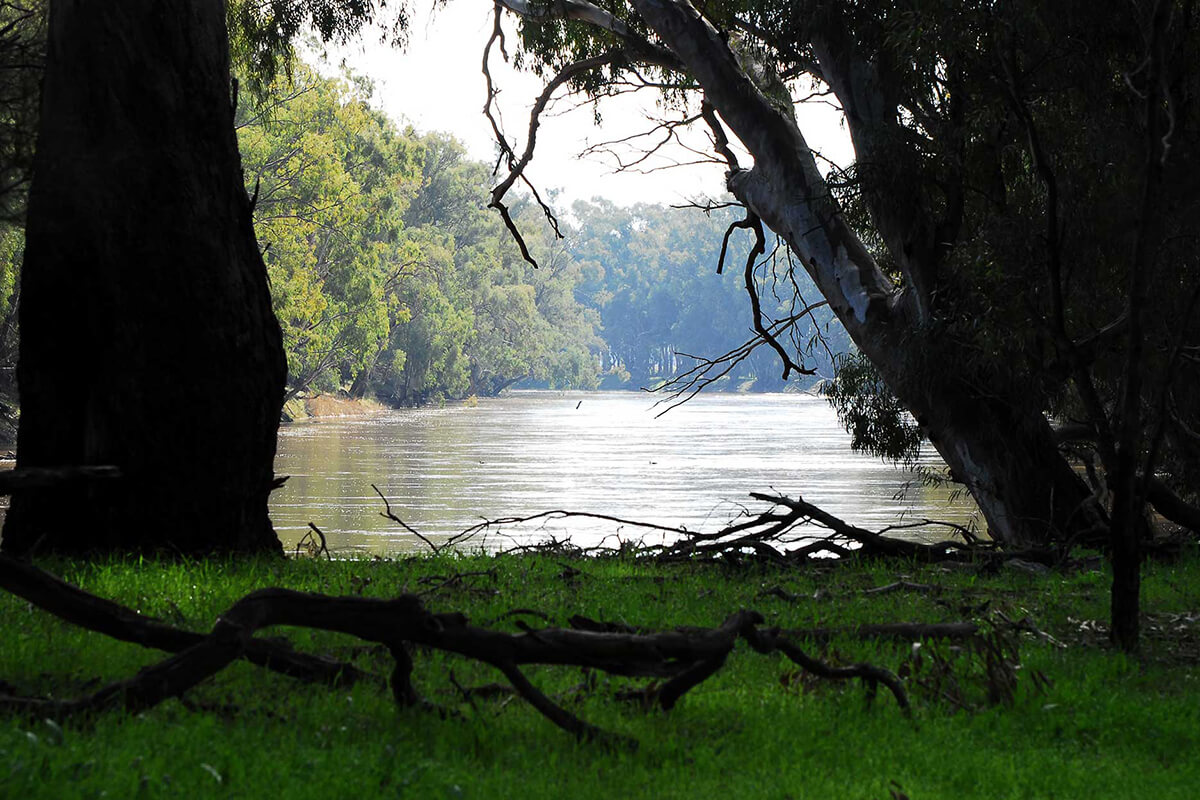
Flow limit options
The frequency, timing, extent and duration of environmental flows has a powerful effect on the landscape and the thousands of species calling it home.
Smaller flows stay within the river channel. Slightly higher flows reach higher up channel banks, and in some areas, spread into floodplain creeks and billabongs; reconnecting the wetlands and providing important habitat for wildlife.
Current limits on releases for environmental flows in the Murray and Murrumbidgee Rivers are capped at relatively low levels. This means rivers and floodplains are connecting less often than they need to maintain healthy ecosystems and once did.
The Reconnecting River Country Program is an opportunity to consider a range of increased flow limit options for releases for environmental purposes to provide greater flexibility in the Murray and Murrumbidgee River systems.
The program will allow more flexibility in the delivery of flows and give water managers the ability to:
- reinstate some natural flow patterns
- trigger breeding and movement of native fish, waterbirds and other water-dependent animals
- release and transfer carbon and nutrients underpinning the aquatic food web
- enhance native fish populations and support healthy river and wetland ecosystems
- improve the health of forests, woodlands and shrublands along river corridors and on low-lying floodplains.
Flows of different sizes and duration would achieve a range of outcomes for river and wetland health, connectivity and wildlife. To mimic natural flow patterns, environmental flows need to vary in size, with a mix of smaller events and some larger events up to the flow limit.
Flow limit options are the basis for:
- modelling inundation footprints
- assessing community benefits and impacts
- assessing environmental benefits and risks
- measuring outcomes for First Nations people
- identifying opportunities and mitigation measures.
The program involves collaboration with landholders, First Nations people, public landholders, and other stakeholder groups across the Murray and Murrumbidgee Valleys.
Stakeholders have the opportunity to provide feedback on flow limit options, impacts and benefits, and project measures.
The following flow limit options are currently informing technical studies being progressed in the Murray and will be assessed in a future Final Business Case. Additionally, other flows within these ranges could be explored in the future.
A recommended flow limit for the Murray cannot be determined until the benefits and risks for all flow limit options, including a cost benefit analysis, are considered in a detailed Final Business Case.
- 25,000 ML/d – current operational limit in the Water Sharing Plan (WSP)
- 30,000 ML/d
- 35,000 ML/d *
- 40,000 ML/d
*35,000 ML/d flow limit options were added for both Hume to Yarrawonga, and Yarrawonga to Wakool Junction in early 2023, enabling a more robust assessment of the change in impacts and benefits across the range of flows being investigated.
- 15,000 ML/d - current temporary operational limit
- 25,000 ML/d
- 30,000 ML/d
- 35,000 ML/d *
- 40,000 ML/d *
- 45,000 ML/d
*35,000 ML/d flow options were added for both Hume to Yarrawonga, and Yarrawonga to Wakool Junction in 2023, enabling a more robust assessment of the change in impacts and benefits across the range of flows being investigated.
- 22,000 ML/d (current temporary operational limit)
- 32,000 ML/d (current operational limit at Gundagai in the WSP)
- 36,000 ML/d
- 40,000 ML/d *
*The Final Business Case submitted to the Australian Government assessed the options and recommended a new upper flow limit of 40,000ML/day (at Wagga Wagga).
Understanding environmental flow patterns
To maximise the benefit of environmental flows, water managers schedule water deliveries to support specific ecological outcomes, such as native fish breeding, waterbird nesting and river productivity.
The timing of environmental flows need to align with the lifecycle requirements of these native plants and animals.
Environmental flows are scheduled to:
- trigger native fish and other wildlife to breed
- encourage food production in rivers and wetlands
- open additional habitat for nesting, foraging and feeding
- provide essential nursery habitat for a variety of wildlife.
Flows can also be delivered to provide drought refuge (i.e., river or wetland environments providing habitat for wildlife during extended dry spells).
When planning the delivery of water for the environment, environmental water managers and holders consider the:
- availability of water in dams and river systems
- condition of the target site and catchment prior to a proposed event
- current health of the native plants and animals in the target ecosystem
- current river flows which may influence delivery of water for the environment
- forecasted weather events with the potential to influence river flows
- needs and input of landholders whose properties are located along the flow corridor.
Environmental flows enabled by the program would often occur in response to a natural trigger, such as rainfall or inflows from tributaries downstream of major dams. These flow releases would typically occur in winter or spring, in line with natural flow patterns and lifecycle requirements of native plants and animals.
Most environmental flow releases are likely to occur from August to October, with river rises occurring slightly later in downstream areas as these flows move through the system. This reflects the natural high flow season, and timing of ecological processes such as fish and waterbird breeding.
Environmental releases might occur slightly earlier in May to July, or slightly later in November. Releases between December to February would be rare and would mostly involve augmenting an existing flow event to improve environmental outcomes or to reduce hypoxic blackwater risk.
Water for the environment may be released soon after rain or a natural inflow event to build on the event (if there is little risk of exceeding the flow limit), or later when the peak has passed to slow the rate of fall (recession) and maintain water in priority wetland areas.
The management of water for the environment is adaptive, meaning flows are closely monitored as they progress and adjustments are made to accommodate changes in weather, inflows or other factors.
The frequency of environmental flows is guided by the needs of the environment. These needs are reflected as environmental water requirements detailed in Long Term Water Plans. The plans help inform the management of water for the environment over the longer term.
The frequency of flows depends on a range of factors. Water managers work closely with river operators, researchers, community advisory groups, landholders and other stakeholders to decide where and when water for the environment can deliver the best possible outcomes.
For instance, water for the environment may be added to a natural event to extend the area or duration of inundation. Another factor is the landscape itself. The lowest lying wetland and floodplain areas may require a period of inundation almost every year or every second year. Alternatively, areas of slightly higher ground may require inundation less often (i.e., every second or third year).
While natural high flow events meet some of these needs, in many cases smaller sized events are required more often to support wetland plants and provide regular opportunities for native fish and other aquatic life to move between rivers and wetlands to breed and grow.
The frequency of higher flows is targeted at supporting the natural cycle of floodplain forests and woodlands and are important for waterbird breeding. They also boost aquatic food webs, which are key ensuring native fish, waterbirds and other animals have enough food to thrive.
The frequency of environmental flows will vary over time, comprising some smaller events and some larger events up to the flow limit. In sequences of wet years, when unregulated flows above the current limit occur frequently, there may be a lower number of environmental flows. In sequences of dry years when water allocations are low, there may also be a lower number of environmental flows. In sequences of years with moderate rainfall and water allocations, the frequency may exceed the average and there may be environmental flows in multiple consecutive years. In some decades (e.g., very wet or very dry) there would likely be fewer deliveries). In other decades there may be more deliveries, comprising some smaller events and some larger events up to the flow limit.
Environmental flow events and the associated low-level inundation of private and public land may follow an irregular pattern. For example, events may occur over consecutive years followed by a break of one or several years, depending on factors such as when the natural triggers occur, environmental watering priorities and water availability.
View proposed flows at inundation mapping.
Relaxing constraints would allow water managers to periodically deliver flows to wetlands and low-level floodplain vegetation communities that can’t be watered at present. This would increase ecological outcomes and help to rehabilitate struggling areas that have not seen the frequency of flows needed to support healthy and resilient ecosystems.
Before river regulation, these areas received more frequent flows supporting the health of extensive areas of wetlands, river red gum and black box forests and woodlands and other wildlife.
The program has published mapping showing the expected upper limit of inundation associated with each of the flow limits assessed.
View proposed flows at inundation mapping.
The duration of environmental flow events varies along the river system, due to natural flow attenuation processes, with slightly longer durations expected in lower reaches of the river.
Environmental flow event durations are guided by water requirements established in Long Term Water Plans and depend on water availability, the time of year, existing catchment and ecological conditions and watering requirements at the time of the event. The duration also varies between valleys and locations in valleys. Wetlands retain water for longer than floodplains that shed water back to the river as flows recede.
The length of time private and public and public property would be inundated during these events would vary depending on the elevation and geography of the land.
Modelling to inform decision-making
The NSW Government has developed comprehensive hydraulic modelling for the program area. This modelling demonstrates the predicted extent of inundation across the program area at various flow limits options considered by the program, and is presented a package of interactive inundation maps.
They have been developed using comprehensive hydraulic modelling, which was cross-referenced against satellite imagery and aerial photography collected during similar recent high flow events in the Murray and Murrumbidgee valleys. It enables landholders and other stakeholders to get a greater understanding of the periodic and low-level inundation expected along the proposed flow corridors that will occur during higher environmental flows.
Two types of maps are available:
- interactive, online maps for the entire program areas showing the predicted upper limits of inundation associated with the flow limit options considered.
- higher resolution property-scale maps are also available for potentially affected landholders through an application process. These property-scale maps include information such as property boundaries and infrastructure, aerial imagery and property-scale inundation.
The maps are a major improvement on the previous modelling used for constraints management projects and are the result of a significant investment by the Australian and NSW Governments.
Development of the inundation mapping has involved an extensive data collection program providing high quality data inputs to model development and calibration, as well as desktop checking against available aerial photography and satellite imagery. Mapping may be updated over time in response to landholder feedback obtained during engagement and, new information becoming available.
To view the maps, visit the program’s inundation mapping.
In the Murrumbidgee the program continues to engage with landholders to seek valuable feedback to help ongoing development of the program.
Landholder engagement for the program’s Murray Project is currently paused, to enable the development, publication (December 2024) and Basin state consideration of the of the MDBA Constraints Relaxation Implementation Roadmap.
NSW is actively working with Basin jurisdictions on next steps for a future project in the Murray.
If you are a landholder within a proposed flow corridor, register to participate in the program by completing the Landholder registration form.
View a recording of the program’s Introduction to modelling webinar held on 27 June 2022.
Contact us
For more information call us on 1300 081 047 or email us at water.enquiries@dcceew.nsw.gov.au