
Check the rules and take the next steps
Non urban water metering helps ensure water is measured accurately and shared fairly across NSW. If you take licensed water, you may need a meter - but what’s required depends on your licence, entitlement and works.
This page helps you quickly work out whether the metering rules apply to you, what equipment you need, and what to do next.
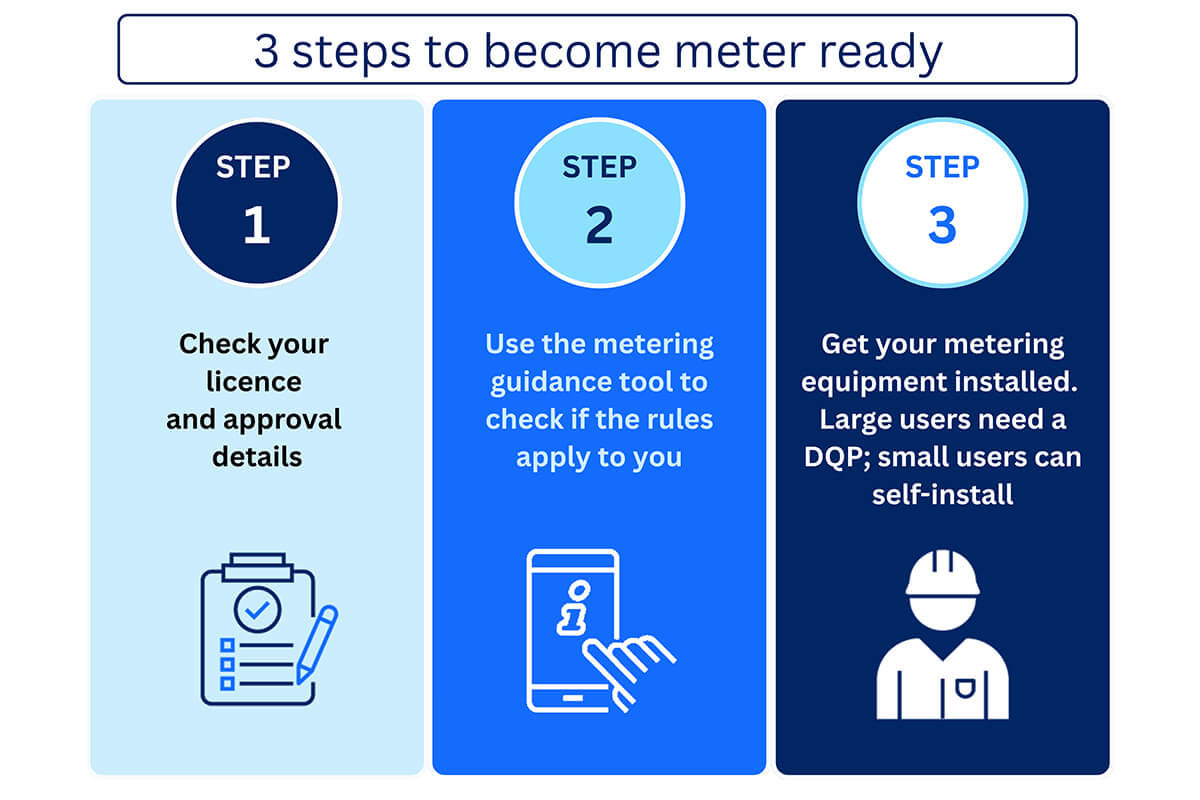
Step 1: Check your licence and approval details
Your Water Access Licence (WAL) and Water Supply Work Approval (WSWA) are your key sources of information. If your WAL and WSWA are linked, the metering rules may apply to you.
Use the NSW Public Water Register to check your details. Watch the NSW Public Water Register video if you need help using it.
Work size matters
Make sure the recorded sizes of your pumps and bores match what’s installed as these measurements determine whether the metering rules apply.
Update incorrect information immediately
If your works are smaller than what’s listed on your approval, you can notify WaterNSW of this. If your works are larger than what’s listed on your approval, book a meeting with WaterNSW to update your records.
Classify works not taking licenced water – they are exempt
If a work is not taking licenced water, you must classify it to be exempt from the metering rules. You can do this at no cost for a limited time through WaterNSW.
Watch the video on how to make these changes or read the classification of work status fact sheet and the guide to amend the classification of your work status.
Need more help? WaterNSW offers one-on-one meetings to discuss your situation.
More information on works classifications can be found at Exemptions section below.
Step 2: Check what metering applies to you
How to find your total/cumulative water entitlement
Your total entitlement is the combined volume of all licences linked to your work approval.
You can use the how-to find your cumulative water entitlement step-by-step guide or watch the How to find your water entitlement video.
After confirming your works and total entitlement, you will fall into one of the following four water user groups:
- Larger: surface water pumps 500 mm or greater, or a total entitlement of 100ML or greater
- Smaller: total entitlement greater than 15ML and less than 100ML
- Exempt: total entitlement 15 ML or less
- Water allocation dealings (temporary trades)
Now use the Metering Guidance Tool. It's a quick, interactive resource that helps you understand exactly which metering rules apply.
Note: If you have a government-owned meter in the Southern Basin, Hawkesbury–Nepean and Bega regions, WaterNSW is responsible for ensuring it meets the required standards, so you do not need to follow the guidance on this page. For questions related to government owned meters, contact WaterNSW on 1300 662 077 or email meter.maintenance@waternsw.com.au
Step 3: Get your metering equipment installed
If you are required to meter, you must install the correct equipment by your compliance date.
Find information for each water user group below
Large water users fall into 2 categories, each with different compliance dates:
- Large by pump size: applies to surface water pumps 500 mm or larger. This group must be compliant now.
- Large by entitlement: applies where total water entitlement is 100 ML or more.
- Inland areas: must be compliant now
- Coastal areas: must be compliant by 1 December 2026
What you need
A pattern approved meter
You cannot install just any meter. Large water users must use a pattern‑approved meter, installed by an approved installer called a Duly Qualified Person (DQP). Pattern‑approved meters are tested for accuracy, and installation to AS4747 ensures the meter is fitted and working correctly.
A full list of pattern approved meters is available from the Commonwealth Department of Climate Change, Energy, Environment and Water.
Approved telemetry for automatic reporting
As a large water user, you must install approved telemetry called a Local Intelligence Device (LID). A LID automatically sends your hourly water use data to WaterNSW daily, removing the need for manual recording and reporting.
You can log in to view your water use at any time through the Data Acquisition System (DAS) to help manage and plan your water use.
Check the list of approved LIDs and use the online coverage tool to see if telemetry is available at your site. If telemetry coverage isn’t available, you may be eligible for a telemetry exemption (see Exemptions below).
Financial support
You may be eligible for financial support through the Telemetry Uplift Program - making telemetry more affordable for Murray–Darling Basin water users.
Installation by a DQP
The type of DQP you need depends on where your meter will be installed.
- Pumps and bores: use a Certified Meter Installer and Validator (CMI) or Trade Meter Installer (TMI). You can find a CMI or TMI on the Irrigation Australia certification directory. (Tips for using the directory)
- Channels, regulators, flumes and weirs (partially filled pipes): use a hydrographer. You can find a hydrographer through the Australian Hydrographers Association website.
Recording and reporting
Good news - with a LID installed, no manual recording or reporting is required.
Maintenance
Your meter is an important asset. To protect your investment and ensure accurate water records, you are required to maintain it in line with the Maintenance Specifications.
Check what you need to do in the documents below:
- Checklist template for approval holders
- Fact sheet – Approval holder maintenance
- Fact Sheet – DQP maintenance
- FAQ – Maintenance Specifications
What to do if your meter or telemetry stops working?
If your metering equipment is faulty or if telemetry connection is lost for more than 3 days, you must notify WaterNSW within 24 hours. If you do not report a faulty meter, it is a breach of the Water Management Act 2000.
You must comply by 1 December 2027 or when your work approval is renewed, whichever comes later.
What you need
A pattern approved meter
You cannot install just any meter – you must install a pattern approved meter, listed on the Commonwealth department’s webpage. These meters have been independently tested and certified to meet national accuracy standards, so you know your readings are accurate and reliable.
Small water users can install their own pattern-approved meter.
Telemetry is optional for small water users, but it can make things easier by automatically sending your water‑use data to WaterNSW. Use the telemetry coverage tool to check if it’s available at your site.
Self-installation guidance
To support self installations, we’ve created an easy to-follow design guide and checklist to help you set up your meter correctly. These resources cover the most common types of installations. If your setup is more complex or site specific, you may need extra support (see Terms of Use).
More information on installation designs, including groundwater, can be found at: Non-urban metering for installers.
Register your self‑installed meter
Self-installations must be registered with WaterNSW using their Installing a new meter online form. If you need help, please call the WaterNSW Customer Service Centre on 1300 662 077.
Getting help with complex installations
If your setup is more complex, you can get help from an irrigation store or a qualified meter installer called a duly qualified person (DQP). The type of DQP you need depends on where your meter is installed:
- Pumps and bores: use a Certified Meter Installer and Validator (CMI) or Trade Meter Installer (TMI). You can find a CMI or TMI on the Irrigation Australia certification directory. (Tips for using the directory)
- Channels and regulators (partially filled pipes): use a hydrographer. You can find a hydrographer through the Australian Hydrographers Association website.
Recording and reporting
If you’re not using a LID, you must manually record and report your water take.
- Check your reporting requirements using the WaterNSW online interactive tool
- Log in to iWAS anytime to manage your water account
- Visit the WaterNSW recording and reporting webpage to login or register.
Maintenance
Your meter is an important asset. To protect your investment and ensure accurate water records, you are required to keep it maintained in line with the Maintenance Specifications.
Check what you need to do in the documents below:
- Checklist template for approval holders
- Fact sheet – Approval holder maintenance
- FAQ – Maintenance Specifications
What to do if your meter or telemetry stops working?
If your metering equipment is faulty or if telemetry connection is lost for more than 3 days, you must notify WaterNSW within 24 hours. If you do not report a faulty meter, it is a breach of the Water Management Act 2000.
This exemption does not apply if you have a surface water pump of 500mm or larger.
What you need
Not required to install metering equipment.
Recording and reporting
- Check your reporting requirements using the WaterNSW online interactive tool
- Log in to iWAS anytime to manage your water account
- Visit the WaterNSW recording and reporting webpage to login or register.
Metering for water trades is not tied to a compliance date. Instead, it depends on how much water you hold after the trade.
If your trade increases your total entitlement above key thresholds (15 ML or 100 ML), you must meet the relevant metering requirements before the trade can be approved. See the applicable requirements under the water user group categories above.
For more information on the metering requirements for temporary trades, read the important changes to temporary trades factsheet.
You can also contact the WaterNSW Customer Service Centre on 1300 662 077 or email Customer.Helpdesk@waternsw.com.au
Recording and reporting
- Check your reporting requirements using the WaterNSW online interactive tool
- Log in to iWAS anytime to manage your water account
- Visit the WaterNSW recording and reporting webpage to login or register.
Maintenance
Once installed, your meter must remain in place and compliant at all times. To protect your investment and ensure accurate water records, you are required to keep it maintained in line with the Maintenance Specifications.
What to do if your meter or telemetry stops working?
If your metering equipment is faulty or if telemetry connection is lost for more than 3 days, you must notify WaterNSW within 24 hours. If you do not report a faulty meter, it is a breach of the Water Management Act 2000.
Exemptions
Not every work needs to follow the metering rules. Use the table below to quickly find out if an exemption applies to you.
Find out if you are taking water under a basic landholder right.
Only works that are nominated by a licence are required to meter. To remove a nominated work from your licence, contact Water NSW or your licensing authority department.
If there is only one work on the property, the size thresholds are:
- Groundwater bore: less than 200mm in diameter is exempt.
- Surface water pump: less than 100mm in diameter is exempt.
If there is more than one pump or bore, the maximum diameter for each decreases to remain exempt:
Surface water:
- 2 pumps: Max 74mm each.
- 3 pumps: Max 49mm each.
- 4 pumps: Max 39mm each.
Groundwater:
- 2 bores: Max 159mm each.
- 3 bores: Max 129mm each.
- 4 bores: Max 119each
This means all pumps or bores must meet the size limit for your total number. For example, if you have two pumps, both must be 74 mm or smaller to be exempt.
These thresholds apply to all pumps or bores on the same landholding, no matter who owns the approval. They also apply to all pumps or bores linked to the same licence, even if they are on different properties.
You are exempt if your work is classified as:
- Constructed, Basic Landholder Rights Only, or
- Constructed, Approval Holder declared not taking water, or
- Constructed, Not Taking Water, or
- Not Constructed, or
- Decommissioned.
To classify your works, go to WaterNSW.
If your work cannot physically comply with the metering rules, you may be eligible for an exemption. You may also be asked to install alternative metering equipment.
For details or to apply, please refer to the fact sheet.
For applications or further information email: regulatory.implementation@dpie.nsw.gov.au
A temporary exemption is available for works that must connect to telemetry but cannot because they are in a site has no network coverage. Check your telemetry coverage to obtain a telemetry exemption.
You are exempt if your work is used only for floodplain harvesting under an approved licence, including regulated, unregulated, or overland flow from a declared floodplain. Read more about the measurement rules for floodplain harvesting.
Important conditions and exceptions
While these works may be exempt from installing a meter, certain conditions still apply:
- Mandatory reporting: Even if exempt from metering, if taking licenced water, you must still record and report your water take. Go to WaterNSW website to find your recording and reporting requirements.
- Water trading: If you trade water in, you may not be exempt - your metering requirements are based on your total entitlement, including any water you’ve traded in, and you must have the required metering equipment installed before you start trading.
- Wells and spearpoints: Wells and spearpoints are considered bores and qualify for the same size-based exemption for bores less than 200mm.
NRAR metering compliance reporting
Metering compliance reporting is available from the Natural Resources Access Regulator (NRAR).
Document library

Visit the resource hub to find links to important documents and guidance tools.
Need more help?

Metering guidance tool
Use the metering guidance tool to check what applies to you.

Questions with the rules
Check out our FAQs or contact 1300 081 047 or email water.enquiries@dpie.nsw.gov.au

Make an appointment with a WaterNSW expert
Make an appointment with a WaterNSW metering expert or visit their Customer assistance webpage for more information.

Subscribe for updates
To be kept up to date with the latest changes subscribe to the mailing list.

Contact us
For more information call us on 1300 081 047 or email us at water.enquiries@dcceew.nsw.gov.au