Acknowledgement
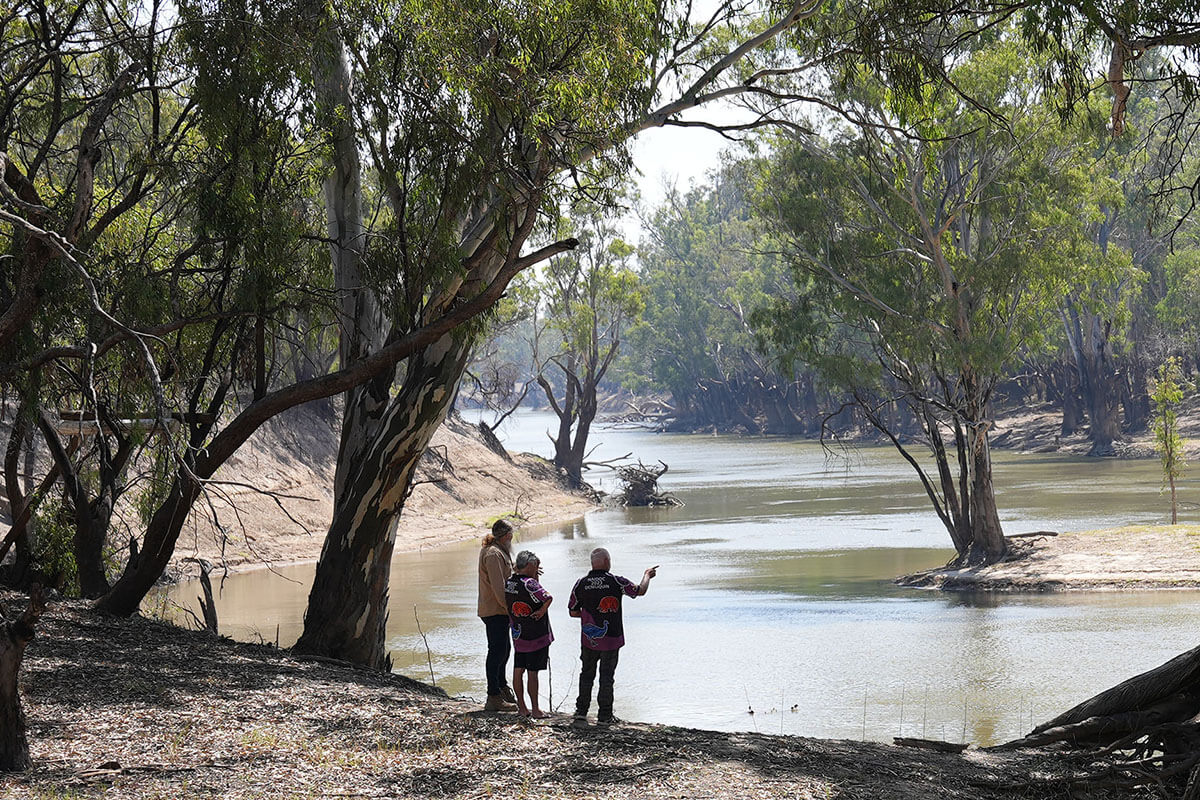
The department acknowledges the Traditional Owners and Custodians of the lands, water and sea country and pays respect to Elders past, present, and future leaders. We recognise Aboriginal and Torres Strait Islander peoples’ unique cultural and spiritual relationships to place and their rich contribution to society.
We show our respect through thoughtful and collaborative approaches to our work. We seek to demonstrate our ongoing commitment to providing places where Aboriginal peoples and communities are included socially, culturally and economically to self-determine their own futures.
Update
A registration of interest for water licence transfers to Aboriginal legal entities process closed in December 2025. The registrations of interest were assessed against eligibility criteria.
Letters with proposed offers were sent on 4 June 2026 to all eligible participants, with a response form. Responses were required by 20 July 2026.
Final offers will be sent in early September to eligible participants who responded that they wished to continue in the process.
Further information is in the frequently asked questions below.
Frequently asked questions
In addition to the frequently asked questions below, there are introductory guides that explain the way water is managed in NSW. Topics include:
- differences between regulated and unregulated rivers and groundwater sources
- how water is allocated
- specific purpose access licences available for Aboriginal peoples
- surface water quality
- groundwater quality
- works and use approvals
- trading water licences
- Trade Dashboard
Information about trading in each water source is available on the NSW Water Register.
General water access licences that have been surrendered to the Minister are being offered. The following categories of water access licence are being offered in certain water sources:
- Regulated river (general security)
- Supplementary water (only in regulated river water sources)
- Unregulated river
- Aquifer
- Aquifer (high security)
Each type of water access licence has different rules about when, where and how the water can be taken. Regulated river access licences cannot be used to take water from unregulated systems or groundwater systems and vice-versa.
An Assessment Panel independently reviewed the process of assessing all registrations of interest to see if they meet the eligibility criteria. The Deputy Secretary Water Group is the decision maker.
Aboriginal peoples are currently estimated to own less than 1% of all licensed water shares in NSW. Transfers of water access licences surrendered to the Minister is a step towards increasing Aboriginal ownership of water access licences that can be used for any purpose including for trade.
The number of shares being offered to eligible participants depends on the number of applications received from other eligible participants in the water source.
General water access licences will be transferred to eligible participants who confirm they accept want to accept an offer. A general water access licence entitles its holder to take a specified share of water from a specified water source, under the conditions set in the relevant water sharing plan.
Water can be taken under a water access licence for any purpose, including agriculture, other commercial, cultural, or environmental purposes. An approval to authorise the work (e.g. pump or bore) required to take the water is also
These water access licences can also be traded.
No, these water access licences are ongoing. This means if a participant is offered and accepts a water access licence under the registration of interest process, they can hold that access licence forever unless they sell the licence or shares to someone else (via trade) or surrender the access licence and shares back to the Minister.
Yes. Even though transfer of the licence to an Aboriginal entity is free, there is a minimum annual water charge to hold a water access licence based on the number of licence shares held. If water is physically taken from the water source there is also a charge for the volume of water taken. The purpose of these charges is to cover part of the cost of water management by government agencies.
There is a minimum annual charge to hold a water access licence, set by the Independent Pricing and Regulatory Tribunal. For the 2026-2027 water year it is $298.97. This means that regardless of the number of shares owned or the volume of water taken, a licence holder will need to pay at least $298.97 for that year. The charges need to be paid each year, and the amount will generally increase per water year (same as a financial year) to reflect that costs increase.
Water management charges for unregulated and groundwater access licences are typically cheaper as these systems require less management by water agencies.
More information about water management fees and charges.
If a participant already holds a licence in one or more of these water sources, the shares offered can be added to the existing licence. The participant can hold multiple licences in the same water source; however annual water management charges will have to be paid on each of those licences. If a participant holds an existing water licence and is offered additional shares in that same water source through this process, the NSW Government is covering the costs for the dealings to combine those shares with their existing licence.
More information on dealings.
The department’s Water Enquiries team is available to provide support on any general water-related questions, complaints, feedback or suggestions. WaterNSW also has a customer service centre that provides information on licensing and approvals, metering and trade.
The department and WaterNSW cannot arrange the actual trade of water access licences, shares or allocation between different parties. Participants can privately engage a water broker to assist with the trading process.
Participants who accept an offer for a water access licence will need to be responsible for the costs for any infrastructure they need if they wish to take water or apply for approvals. Participants are encouraged to look for any NSW or Commonwealth government grants that may become available in the future that could help to financially support those requirements.
There may be opportunities in the future for water held by the NSW Minister of Water to be made available. The water available through this process is a result of licences that have been accumulated over many years.
Transfers of water access licences held by the Minister is a step towards increasing Aboriginal ownership of water access licences that can be used for any purpose or traded.
Aboriginal people, including individuals, can apply for an Aboriginal cultural water specific purpose access licence (SPAL) in all water sources in NSW. These are licences to take water for cultural purposes. There are no costs to apply for them and currently (until at least mid-2029) no costs to register a licence that has been granted or any ongoing water management charges. There is a limit of 10ML/yr per licence, except in the Murrumbidgee Regulated River Water Source. There are restrictions on purposes they can be used for.
In some water sources, Aboriginal community development SPALs and supplementary water (Aboriginal environmental) access licences can also be applied for and granted. Aboriginal community development licences can be used for commercial activities owned and/or operated by Aboriginal organisations and in some cases can be traded for the same use.
These specific purpose access licences can only be granted for their specific purpose.
Native title holders can take and use water to exercise native title rights without needing an access licence, water supply work approval or water use approval. Native title rights only apply to people with a native title determination which specifies land and water, and only for the purposes listed in the determination. Native title holders cannot construct dams or bores without approval. Take under native title rights does not require a licence and therefore does not need to adhere to water sharing plan cease to pump rules – meaning they can take water whenever it is needed.
Water can be taken once:
- the water access licence has been transferred from the Minister to the new licence holder, and the transfer has been registered with NSW Land Registry Services,
- approvals for all works (e.g. pumps or bores) that are needed have been obtained,
- the licence nominates (identifies) the approved works as the means by which water will be taken under the licence.
Once participants can start taking water under a licence, they are responsible for ensuring they only take water when it is permitted under the licence conditions.
Water does not have to be taken under a licence. The licence can be traded. Works and approvals for those works are not required unless the licensed water is going to be taken.
Yes. These access licences, shares or water allocation can be traded in the same way that all other licences can be traded under the rules of the relevant water sharing plan and the Access Licence Dealing Principles Order 2004.
If the intent is to trade water to generate income, it is recommended you investigate whether there is an active water market in the water source to which the licence applies before accepting any offer of licensed water. Information about previous trades is free of charge.
There are application fees to do trades (dealings). Find more information on those costs.
This video explains how to navigate the Trade Dashboard and find whether there is an active trading market (temporary or permanent trades) in specific water sources, including volume and average weighted prices per share.
There is a notable difference in the trading rules for coastal and inland water sources:
In coastal NSW, trading between regulated, unregulated and groundwater sources is not permitted. Trading may be allowed between some highly connected unregulated and alluvial groundwater sources, but this will be specified in the relevant WSP. Water cannot be traded across areas that are not hydrologically connected (that is, where the water sources do not drain into or out of each other). Where there are high ecological values, trade is generally not allowed.
Inland alluvial groundwater plans generally do not allow trading out of groundwater sources. Most inland plans restrict trading across water sources, e.g. trade is only permitted within the same groundwater source. Trading between surface water and groundwater is generally not permitted in inland systems.
Information about water trading in NSW can be found on the departments Trade webpage and the WaterNSW Trading Water webpage. Note this is mainly applicable for inland areas however there is general information which applies across NSW.
Information about water trading in coastal NSW can be found water trading in coastal NSW fact sheet.
The general water access licences transferred to eligible Aboriginal entities from this ROI can be permanently sold to non-Aboriginal persons or entities in the same way that anyone else can sell a water access licence.
Through permanently or temporarily trading a water access licence the holder will receive money which, consistent with self-determination principles, can be used for purposes that meet the needs of the Aboriginal entity (e.g. community, education, housing etc.).
A bore is usually needed to take groundwater, and a pump is usually needed to take surface water. A water storage (dam) may also be required, such as when large volumes of water are taken at one time for use later (e.g. water taken under a supplementary access licence).
There may be other equipment required like a reticulation system to move water around the property from the dam or water source.
Depending on the water source, and the number of shares that you obtain through this process, and the type and size of infrastructure you use to take water, you may need to install a meter on your pump, bore or storage and you will need to comply with recording and reporting requirements. If a meter is not required, you will still need to record and report the volume of water taken by your water supply work.
More information about metering can be found on the non-urban metering for water users webpage and through the metering guidance tool.
WaterNSW issues bills in arrears that include the licence holder’s entitlement charges as well with any usage charges.
Charges for unregulated and groundwater water sources are billed annually. The usage charges are based on meter readings, or if no meter is installed the full entitlement for the 12-month period from July to June (otherwise known as the ‘water year’). Annual bills for unregulated river water sources are usually issued in September for the previous water year. Annual bills for groundwater sources are usually issued in October for the previous water year.
Charges for regulated river water sources are billed quarterly. Water sources within Greater Sydney are also billed quarterly.
Visit WaterNSW for more information regarding billing and accounts.
Groundwater and unregulated river management prices are based on either a one-part or a two-part tariff.
One-part: The licence holder does not have metering equipment, so is billed based on your full entitlement (number of shares held) regardless of how much water has been used.
Two-part: The licence holder does have metering equipment, so is billed a lower entitlement rate plus a usage charge based on the actual water use. Please note, work/s that have been classified as not taking water are not eligible for a two-part tariff.
If a licence holder is billed a 2-part tariff, the minimum charge will still need to be paid each year. The final amount depends on the actual amount of water taken.
If a licence holder does not plan to take any water from that water source, a 1-part tariff will be charged. This means that the licence holder will be required to pay the full annual charges for that water source, even though no water is being taken or used.
Visit WaterNSW for further information regarding water management fees and charges.
Yes, however annual water charges will still apply. These charges will be reduced if the licence holder has metering equipment that records that water was not taken.
In regulated water sources, water is ordered and stays in the river until the licence holder that ordered the water takes it out. If it is not taken by the licence holder it can remain in the river and that portion of water will not be taken by other users. In regulated systems, if an Aboriginal licence holder wants the water to stay in the river for environmental purposes, an Aboriginal cultural water specific purpose access licence could be used to achieve this purpose. Unlike general water access licences, these do not have annual water management fees and are free to apply for.
In unregulated water sources, water is shared between licence holders, the environment and people with basic landholder rights based on the rules in the water sharing plan. Water is not ordered, and users take water depending on rules in the water sharing plan, often related to the amount of water in the river. For example, if a water sharing plan says water cannot be taken when the river flows are below 5 ML/day, licence holders must stop taking the water until flows exceed this again. This means that any water which is left in the system may not be protected from being taken by other users.
All water sources across NSW are managed under a water sharing plan and the requirements of the Water Management Act 2000. Water sharing plans include the rules and access conditions for each water source. They set limits on the extraction of all water in the water sharing plan area (called a long-term average annual extraction limit) and include rules for water trading, water accounts and when water can be taken.
Additional rules apply to groundwater works (bores, wells and pumps) to minimise the impacts on the water source (volume and quality of water), dependent ecosystems and other groundwater users.
The rules in water sharing plans and the regulations result in mandatory conditions on an access licence or a water supply work approval that you will need to comply with to take water.
More information:
Yes. Eligible applicants may choose to trade the water with other people who have infrastructure to take water or seek approval for and construct the relevant infrastructure to take water later. However, the licence holder will be liable for water management fees even if no water is taken out of the water source.
Water access licences and water supply work approvals can be handed back (surrendered) to the Minister. There are administrative costs involved with surrendering a water supply work approval - currently between $123.17 and $273.44.
The annual water charges will also need to be paid for the time the access licence is held.
Feedback
The department is seeking feedback about your experience with the registration of interest process, barriers faced and ideas for improvement.
Project background
The NSW Government is committed to increasing access to, and licensed ownership of, water for Aboriginal peoples.
The department’s ROI project aims to:
- contribute to the NSW Water Strategy’s and the Closing the Gap National Agreement’s commitment to increase Aboriginal peoples’ ownership of water
- increase Aboriginal peoples' opportunities to take and use water for any purposes
- create more opportunities for Aboriginal entities to enter the water market.
From time to time, water licences are surrendered to the NSW Minister of Water for a variety of reasons.
These access licences are more versatile than specific purpose access licences because they can be used for any purpose, including agriculture, other commercial, cultural or environmental purposes.
They can be traded permanently or temporarily and are granted in perpetuity until traded or surrendered to the Minister.
Interactive map of water sources
The interactive maps below show the surface water and groundwater sources that were made available during the ROI.
How to find trading information
The video below explains how to navigate the Trade Dashboard and find whether there is an active trading market (temporary or permanent trades) in specific water sources, including volume and average weighted prices per share.
Registration of interest information
This ROI process is available only to Aboriginal legal entities that are not an individual person or a sole trader (for example, a company, a statutory body or an incorporated association). In addition to being a legal entity of this kind, you must meet both of the following two criteria:
- You must be an Aboriginal-controlled entity. For the purposes of this ROI process, this means that you must be one or more of the following:
- an Aboriginal Corporation registered under the Corporations (Aboriginal and Torres Strait Islander) Act 2006 (Cth)
- a Local Aboriginal Land Council (LALC) under the Aboriginal Land Rights Act 1983 (NSW)
- a Prescribed Body Corporate (PBC) under the Native Title Act 1993 (Cth)
- an Aboriginal Community-Controlled Organisation (ACCO) as set out in clause 44 of the National Agreement on Closing the Gap
- another kind of legal entity that is not an individual or a sole trader and is at least 51% Aboriginal owned, managed and controlled as evidenced by the entity’s ASIC Company Extract, Constitution, Articles or Memorandum of the Aboriginal board of governance.
- You must be based in NSW. For the purposes of this ROI process, this means that you must currently (that is, at the time you submit this form and at all times until you are notified of the outcome of this ROI process):
- have some operations within NSW; and
- satisfy one or both of the following criteria:
- you must have a current registered office in NSW or premises within NSW, and you must carry out operations from that office or premises; or
- you must list your main business location on the Australian Business Register as being in NSW.
These eligibility criteria have been selected by the department to ensure it can contribute to NSW Water Strategy and NSW Aboriginal Water Strategy objectives to increase Aboriginal ownership of water by making water available to as many Aboriginal legal entities as possible.
There were no application fees to participate in this ROI process.
Successful participants will not need to pay any costs to obtain the water access licence/s WALs and/or water shares from the Minister for Water.
However, you will be responsible for any other costs associated with those WALs or water shares. For example, if further approvals under the Water Management Act 2000 are required (for example, if you propose to take and use the water via a pump and pipe and so you need to obtain a water management work approval), you will be responsible for the costs relating to those approvals (including any applications). You will also be responsible for any costs incurred in using any water, as well as any costs to link your WAL to a water management work. You can find more information about fees in the FAQs.
In addition, if you receive a WAL(s) or water shares as a result of this ROI, you will become responsible to pay any further fees and charges associated with that WAL(s) or any water shares and any dealings with it. This may include (for example):
- annual water management charges, which are payable even if no water is taken/extracted from the water source
- any fees for approvals for works (for example, pumps or bores); and
- fees if you choose to trade the water.
You can find more information on other fees and annual water management charges in the FAQs.
Participation in this ROI process is subject to the following terms:
- A reference to a "participant" in this document means a legal entity which participates in this ROI process or who submits a registration of interest as part of this ROI process.
- To maintain the integrity of the ROI process, the department cannot provide advice to any participant in connection with this ROI process, including (for example) advice about:
- whether a participant should or should not participate in this ROI process and register an interest
- the viability of the water source for the participant's proposed uses
- any other matter related to this ROI process or a WAL or share component.
- While the department will make reasonable efforts to ensure the accuracy of the information it provides to participants in connection with this ROI process, the department makes no representations or warranties as to the accuracy, reliability, currency or completeness of the information which it provides. It is each ROI participant's responsibility to ensure that it conducts its own due diligence and obtains its own independent advice.
- Participants must not seek to influence the department, its employees, personnel or agents or any Minister or member of Parliament in relation to this ROI process. Any breach of this requirement may lead to exclusion of a participant from the ROI process.
- Acquiring a right to receive a WAL or a water share through the ROI process does not guarantee that water of a particular volume or quality will be able to be accessed by the successful participant. This is because water volume and quality can vary throughout a water source and because available water determinations, water sharing plan rules (such as cease to pump rules) and other legal requirements can change in the future. If successful participants are unable to access suitable water, they will not be given compensation.
- The following rules will apply, to achieve the department's policy aim to make water available to as many Aboriginal legal entities based in NSW as possible:
- If two or more ROI participants register an interest in the same water source or water management area and are successful as part of this ROI process, the department will, subject to paragraph (b) below, divide the water shares equally amongst those participants as far as reasonably practicable.
- However, if any participant has requested only a specific proportion of the available water share which is less than an equal share for all eligible participants, the department will allocate the water share in accordance with the specific proportions requested by the participant, and equal division may not apply in such a case.
- The department and the Minister retain the right to suspend or terminate the ROI process at any time prior to the grant or conveyance of a WAL or a water share. The Minister or the department are not obligated to award any legal entity any WAL or water share or any water entitlement as part of the ROI process.
- This ROI:
- does not create a contract (including a process or other implied contract)
- does not constitute an offer capable of acceptance
- does not guarantee the transfer of a WAL or any water share to any participant.
- Nothing in this ROI form constitutes any partnership, agency or other relationship between the department and a participant or between the Minister and a participant.
- The rights and discretions given to the department and the Minister in connection with this ROI process are not pursuant to any contract between the department or the Minister and a participant, but instead are rights and discretions which the department or the Minister has as part of this ROI process.
- Once an entity submits this ROI form, it must promptly notify the department in writing of any change to the details that it has submitted or provided to the department in connection with this ROI process.
- The fees and dollar amounts referenced in this document and on the ROI webpage are current as of October 2025 or the date (if any) specified for those fees and dollar amounts. Those fees and dollar amounts may be subject to change. Additional fees and charges associated with water shares, allocations and associated dealings may apply depending on the water share, allocations and the dealing.
- Each participant, the department and the Minister agree to the use of electronic communications and electronic transactions in connection with this ROI process, including as permitted under the Electronic Transactions Act 2000 (NSW).
- To the extent permitted by law, the department and the Minister will not be liable for any claim by a participant, or anyone associated in any way with a participant, in connection with:
- any costs, expenses, loss or other liability which may be incurred by anyone in connection with this ROI process; and
- without limiting paragraph (a) above, any costs, expenses, loss or other liability which may be incurred by any participant in connection with its use of, reliance on, any document, statement or information (express or implied) provided for or on behalf of the department or the Minister in connection with this ROI process (whether verbally, in writing or otherwise).
- The participant is solely responsible for its own costs and expenses in connection with its participation in the ROI process, including but not limited to, the participant's costs in preparing a response to this ROI form.
- In this ROI form, the words "include", "including", "for example" and words of similar expression are not words of limitation and do not limit what they refer to.
By participating in the ROI process, the participant acknowledges and agrees that:
- It is responsible for, and will make, its own independent investigations and conducting its own enquiries and due diligence in relation to the WALs or water shares which are subject to this ROI process.
- If the department or the Minister determines that a WAL or water share is granted or transferred to it in connection with this ROI process, the grant or transfer will be done under a separate process and may include other documents, such as a contract.
- If a WAL or water share is granted or transferred to it in connection with this ROI process, it will be fully responsible for paying all ongoing fees and charges in connection with the WAL or water share (as the case may be), including (for example) the annual water management charges for each WAL, even if no water is taken or extracted from a water source or water management area in connection with that WAL or water share (as the case may be).
- The department may contact it if the department seeks additional information or documents or wishes to clarify anything provided by a participant in connection with this ROI process. A successful participant may also be required to provide the department with additional documents and information to facilitate the conveyance of a WAL or water shares. It is your responsibility to provide such information and documents to the department in a timely manner and, failing to do so may impact our ability to assess a participant's application and to transfer a WAL or share component.
By participating in this ROI process, the participant warrants and declares on a continuing basis that:
- It has not engaged in (and will not engage in) any fraudulent or corrupt conduct or uncompetitive behaviour in connection with this ROI process.
- It has not colluded with anyone else or engaged in any conduct which might be regarded as collusive.
- The participant and (to the best of its knowledge, information and belief) anyone associated with it have not offered, and will not offer, any form of inducement or bribe to any department personnel, any Minister or Ministerial personnel, and other member of Parliament or any other NSW Government employee, contractor or adviser.
- The information provided to the department in connection with this ROI process is true, complete and accurate, and it and its personnel have not engaged in any misleading or deceptive conduct in connection with this ROI process.
- The participant and (to the best of its knowledge, information and belief) anyone associated with it have not engaged in, and will not engage in, any practice which has denied or may deny opportunities for other participants in the ROI process.
- It is legal entity which is not an individual or a sole trader.
Breach of any of the above warranties and declarations may result in a participant being excluded from further participation in the ROI process.
If a participant provides the department or its personnel with any personal information as part of its ROI form or in connection with the ROI process, then the participant:
- represents and warrants that it is duly authorised to provide that information to the department and its personnel
- acknowledges and agrees that the personal information may be collected and used by the department and its personnel for the purposes of facilitating or evaluating this ROI process and the conveyance of any resultant WAL or share component, including enabling the department to consider, process and assess the registration of interest and to contact the participant and provide the participant with information in connection with the ROI process and any WAL, water share or water entitlement which may be granted or transferred as part of that process
- further acknowledges and agrees that:
- the personal information which it provides to the department or its personnel will be protected and handled by the department in accordance with relevant NSW privacy laws, including the Privacy and Personal Information Protection Act 1998 (NSW)
- any personal information which the participant shares with the department or its personnel may be shared in accordance with privacy legislation, including where the department is permitted or required by law to share such information.
Details in relation to how the department manages personal information, as well as information about a person's rights in relation to their personal information, are set out in the department's Privacy Management Plan.
The department may share or exchange any information provided by a participant to the department or its personnel (including employees, contractors or advisers) to the Minister or other State departments or government bodies to facilitate this ROI process and the transfer or grant of any WAL or water share or to evaluate and improve the ROI process.
The department may also share or disclose information in connection with this ROI process where referenced in this ROI form or where required or authorised by law, including under the Government Information (Public Access) Act 2009 (NSW).
Letters to both successful and unsuccessful applicants have been emailed.
Successful applicants will have 42 days to decide whether to accept their offer from the date of the letter. Further information will be provided at that time.
Public information sessions
Below are recordings of the webinars that were held for people to learn more about the registration of interest process for transferring water access licences to eligible Aboriginal legal entities. They are the same presentation, held on different days. All the questions that were asked, and the department's responses are also below.
Question and answer document
Read the questions that were asked during the webinars with responses from the department.
Costs
There is no cost to obtain the licence(s) from the NSW Minister for Water. If you obtain a licence(s) however, yearly water charges apply even if no water is taken from the water source. These costs are listed in the ROI form.
If you choose to take and use the water (rather than trade it), you will need to apply to link your water access licence to an approved water supply work.
The cost to apply for a combined water supply work and use approval differs between surface water and groundwater sources and depends on the location.
Assessment criteria and guidelines
The ROIs were reviewed by an Assessment Panel convened by the department. The Panel endorsed recommendations on eligibility.
Where there was more than one eligible and interested entity in a water source, the Panel endorsed the approach taken to recommending share offers which was to:
- look at the number of shares available in the water source
- look at the number of eligible entity participants who registered interest in the water source
- divide the available shares evenly amongst eligible entity participants
Guidelines
This guideline outlines the approach for the Registration of Interest process that opened on 15 October 2025 for making water access licences held by the Minister available to Aboriginal legal entities.
Need help or more information?
- read the frequently asked questions
- email us at water.enquiries@dcceew.nsw.gov.au
You can call us during business hours or leave a voice mail after hours.
Phone: 1300 081 047
Email: water.enquiries@dcceew.nsw.gov.au
Subscribe for updates
Sign-up for updates about the Aboriginal Water Program. Please see our Privacy policy.